
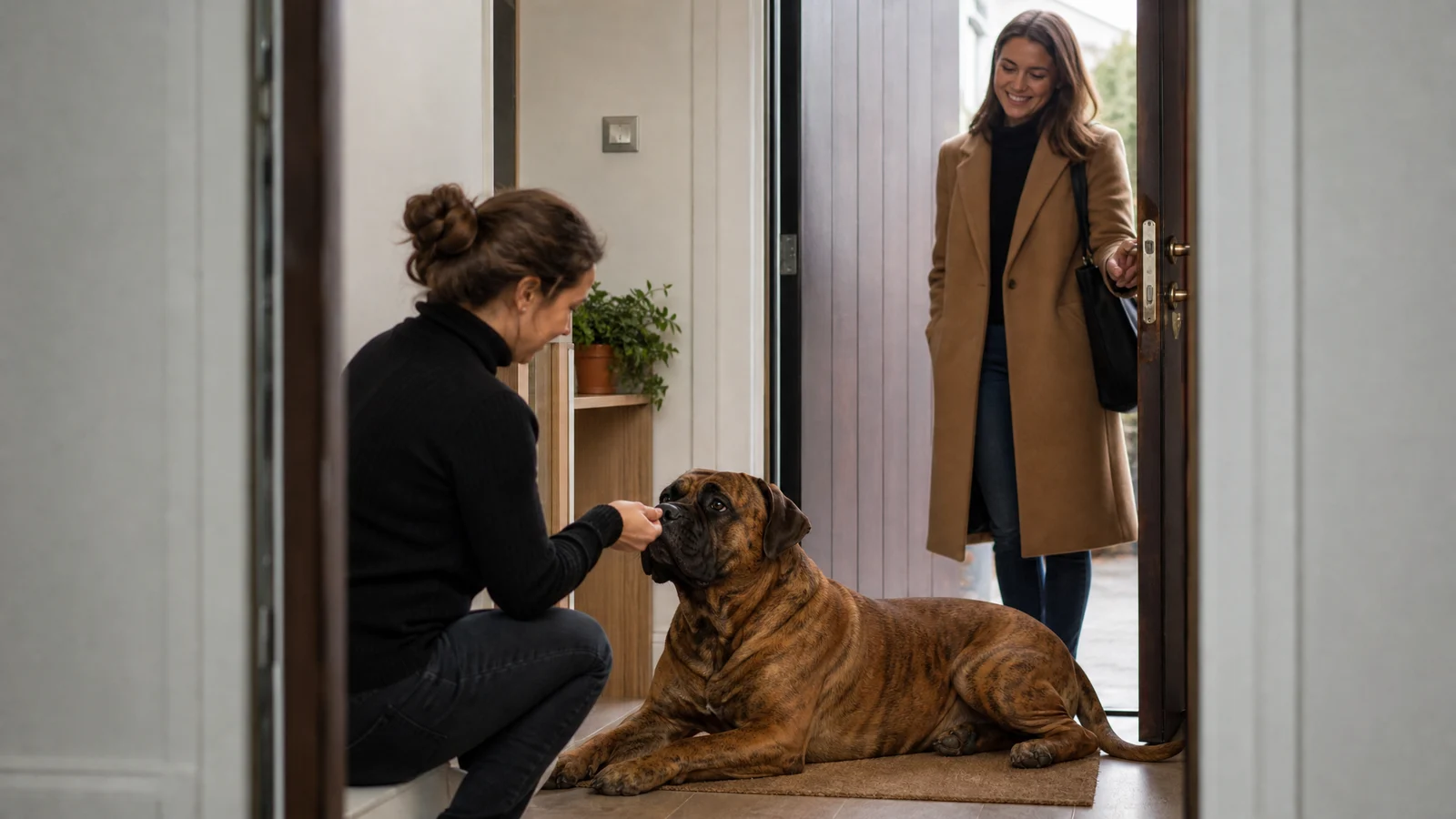
How do you stop a Boerboel from going off when the doorbell rings? People often recommend more socialization, but that advice falls short for this breed. The AKC rates their watchdog nature 5 of 5, the vigilant end of the scale, so a dog wired to notice arrivals keeps noticing them no matter how many people they meet.
Arrivals matter because a keyed-up Boerboel at the door is a big, territorial dog at the moment a stranger steps closer, while a settled one turns the same alertness into a calm lookout. You can't remove the instinct, but you can give it somewhere calm to go.
Read on for the mat cue, rewarded greetings, and gates, then for case files covering an apartment, a household with small children, a second dog in the mix, and an owner who works all day.
Why Visitors Test a Boerboel
A doorbell is never just a sound to a watchful dog. It announces a stranger, a door opening, and usually a quick shift in your voice and posture, so the whole sequence plays like an alarm.
The breed standard describes a protective character that is still evident today and much sought after, and says the dog should recognize a threat or the lack of one.
That second half is the part you can teach. A Boerboel learns that nothing is wrong by living through many arrivals that turn out to be boring, and the same standard prizes calm, stable, confident composure.
Your job is to protect that composure rather than test it, which means keeping door moments short, predictable, and well paid. Socializing still matters, since early socialization is a must for this breed, alongside structured, long-term obedience started young.
But it means teaching the dog what ordinary arrivals look like, not hoping exposure will switch off a vigilant nature. We specialize in Boerboel behavior and training, and every setup below leans on reward-based methods. These tools do the heavy lifting in each case file:
- A mat cue gives the dog a specific, rewarded place to go when the bell rings, which is a job other than barking at the door.
- Rewarded calm means paying for quiet moments around arrival sounds, ideally before any barking begins.
- Gates and a separate space add distance between the dog and the entry, so they never have to face a stranger while still wound up.
Aim for polite rather than sociable. Openness to strangers rates 3 of 5, which reads as ambivalent, and a Boerboel should accept friendly strangers after proper introductions while many stay reserved and aloof.
A settled dog on a mat is a win even if they never greet anyone at all. Polite is the goal, and friendly is a bonus.
Apartment Arrivals and Socializing
Apartment life packs everything a protective dog reacts to into a small footprint: thin walls, footsteps that appear without warning, and a front door only a few strides from the couch. The reassuring side is that the same triggers repeat daily, which gives you plenty of low-stakes practice at socializing the dog to ordinary comings and goings.

Building the Mat Habit
Begin on a quiet afternoon with the mat across the room from the door. The instant a paw touches it, mark the moment with your cue word and drop a treat on the mat itself.
Then ask for a down, count a few seconds, and pay again before releasing, so the mat becomes the best square of floor in the home. Once that is reliable, slide the mat toward the door and play a doorbell recording at low volume, paying whenever the dog heads for the mat or simply stays relaxed.
Raise the volume only while they remain easy, and add a knock later. Barking means the setup became too difficult. Drop back a step and make it easier.
A Barrier Between Dog and Door
With so little distance, a gate does what space cannot. A tall, sturdy pet gate across the entry hall lets the dog watch the door from a calm spot.
For bigger arrivals such as several guests or a repair crew, a bedroom or bathroom they already like works better. Stock it with water, a chew, and a food puzzle, since mental stimulation needs rate 4 of 5 for this breed.
Move them before the knock, not after barking has started, and lead them in with a treat so the room feels like a bonus. A fan or radio on low blunts the hallway sounds and makes the wait easier.
Hallway Practice With Neighbors
Ask a friendly neighbor to walk past, pause outside your door, and knock while you pay for quiet from the mat. Repeat with different people at different times of day.
The more ordinary those footsteps become, the less the dog feels they must comment on them. Keep them leashed in shared hallways, elevators, and stairwells, because this protective breed should never be off leash. In an apartment, you are paying the dog to notice quietly, which is the best version of a watchdog.
Young Kids Meet the Boerboel
The Boerboel is described as loving with children and family, and the breed scores 4 of 5 for young children. That warmth belongs to their own household.
A child's friends are unfamiliar, loud, and quick, and a protective dog may decide the commotion at the door is theirs to manage. For the wider picture of how this breed mixes with kids, other dogs, and outsiders, see our guide to kids, dogs, and strangers.
Who Manages the Dog
An adult, never a child, answers the door and handles the dog. Children can wait in another room while the guest comes in, and on ordinary days they can join the mat game, with a grown-up handing out the treats. A small, safe role keeps kids interested, and it keeps the leash and every decision in adult hands, which matters with a dog this powerful.
Where the Gate Goes
Place a tall gate between the entry and the living area, so guests walk in without passing the dog, who watches from the mat behind it. Rehearse on quiet days: a family member rings, the dog goes to the mat, and treats arrive for quiet. By the time real friends show up, the pattern already exists and nobody has to invent it under pressure.
Supervised Greetings
A greeting happens only when the dog is calm, the guest is seated, and an adult holds the leash. Ask guests to avoid staring and to wait for the dog to come over by choice, then end the greeting while the dog still looks relaxed.
On busy days, skip it altogether and let the mat do the work. When children are running or wrestling, send the dog to their own room with a chew.
That is a break, not a punishment, and kids should learn not to hug the dog or reach over the gate. A dog this size can flatten a small child with a friendly bump, so separate first and mingle later. A visit that ends with the dog resting in their own space counts as a success.
Socializing Two Dogs During Arrivals
A housemate at the door can mean far more than double the work, because excitement spreads from one to the other. The breed scores only 2 of 5 for how well they do with other dogs, and a Boerboel will not take kindly to challenges from another dog, so a housemate is not automatically a calming influence. Plan for each as an individual who happens to share a hallway.
Separate Stations and Rooms
Give each dog a mat set far enough apart that neither can reach the other's treats. Guarding of food and chews is typically rooted in anxiety, and one shared reward spot in the middle of arrival chaos invites tension.
For noisy visits, use separate rooms behind a gate or closed door, and separate them before the bell rather than after the first bark. If a dog stiffens or growls over a chew while guests arrive, treat it as information.
Growls are warnings, so calmly move away and give the dog more room. That shows them nothing is being taken and they have no reason to escalate.
Greeting in Turns
When a greeting is on, bring out the dogs one at a time. The waiting dog stays behind a closed door with a chew.
Alternate who goes first from visit to visit so neither starts treating arrival as a contest, and pay each dog at their own station. Over weeks, the dog who used to copy the other's excitement learns to copy their calm instead. Calm turns out to be just as catching.
Work-Day Socializing and Visitors
When you are out at work, the courier arrives on a schedule, the dog barks, the courier leaves, and the dog learns that barking works. That daily rehearsal is the real problem for a territorial breed, and you cannot pay for calm from the office. So the plan is fewer rehearsals and fewer things to see.
Deliveries and Dog-Walkers
Cut the events themselves. A parcel locker, a trusted neighbor, or a note asking couriers to leave packages without ringing all help, and friends can text before dropping in.
Dog-walkers need a simple routine: the dog is already behind a gate or in a back room with a chew, and the leash is clipped on before the dog comes out. Introduce any new walker while you are home, with treats coming from the walker.
Remove the view too. Window film or curtains on front windows take away much of the trigger, and a gate keeps the dog out of the rooms nearest the door.
If the fence line is the trouble spot, our piece on managing property-guarding behavior covers it, and boredom that turns into chewing is covered in stopping destructive chewing.
Coming Home Routines
Come in quietly, give the dog time to settle, and keep the first greeting low-key. On days at home, practice on purpose: leave a package on the doorstep and put a treat on the mat when the dog stays quiet.
Regular vet visits matter here too, and if a settled dog suddenly reacts to noises they used to ignore, mention it at the next checkup. Fewer rehearsals mean fewer habits to undo.
Boerboel Greetings Over the Years
Expect management to last the dog's whole life. This is a protective, territorial breed that is not suited to a novice owner, so there will never be a day when the doorbell means nothing.
What changes is how quickly they settle and how much effort it takes to get them there. Puppies are usually flexible and easy to guide, and it is tempting to believe that will last, so steady training needs to be well underway before those qualities fade.
In the early months, progress looks like a glance at the door followed by a trip to the mat. Later, barking gets shorter and quieter, recovery gets faster, and you need fewer treats.
When the pliant puppy gives way to an adult with firmer opinions, go back a step rather than calling it failure. For the instinct behind all of this, see guarding instinct at home.
Skip dog parks, too, since they put a dog who dislikes challenges in exactly the wrong spot. With steady practice, greetings do get calmer, and the households who keep the setup are the ones who enjoy it.
This breed will always notice an arrival, and that is part of who they are. With gates and the mat cue as a permanent habit and calm rewarded generously, visits become predictable, and the dog who once rattled at the bell becomes the one who watches from their mat while you open the door.
 BehaviorStop Destructive Chewing in a Boerboel
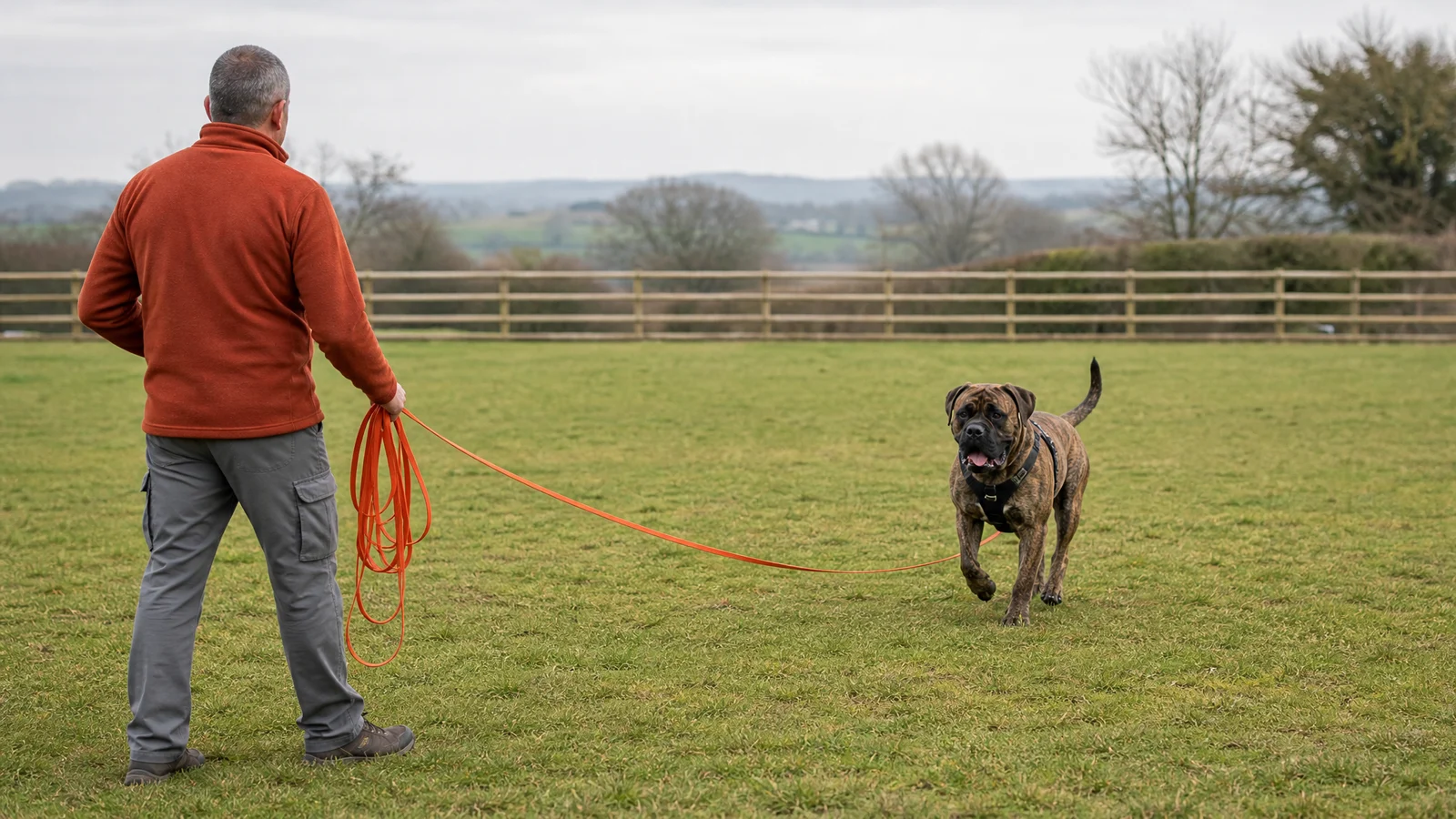 Training basicsRecall Training for a Boerboel Who Never Gets Off-Leash
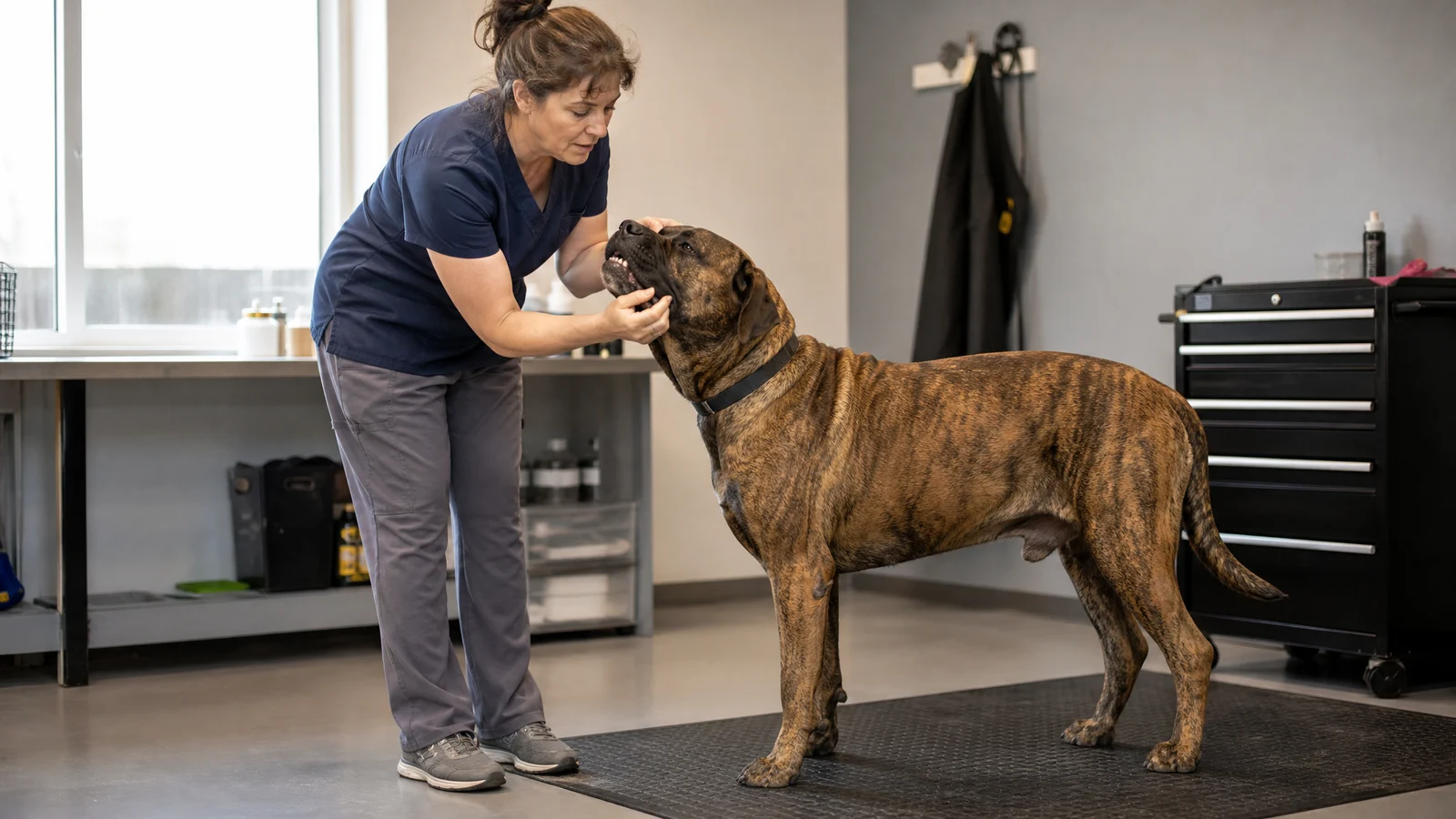 CareTeaching Your Boerboel to Stand for Handling and Examination