
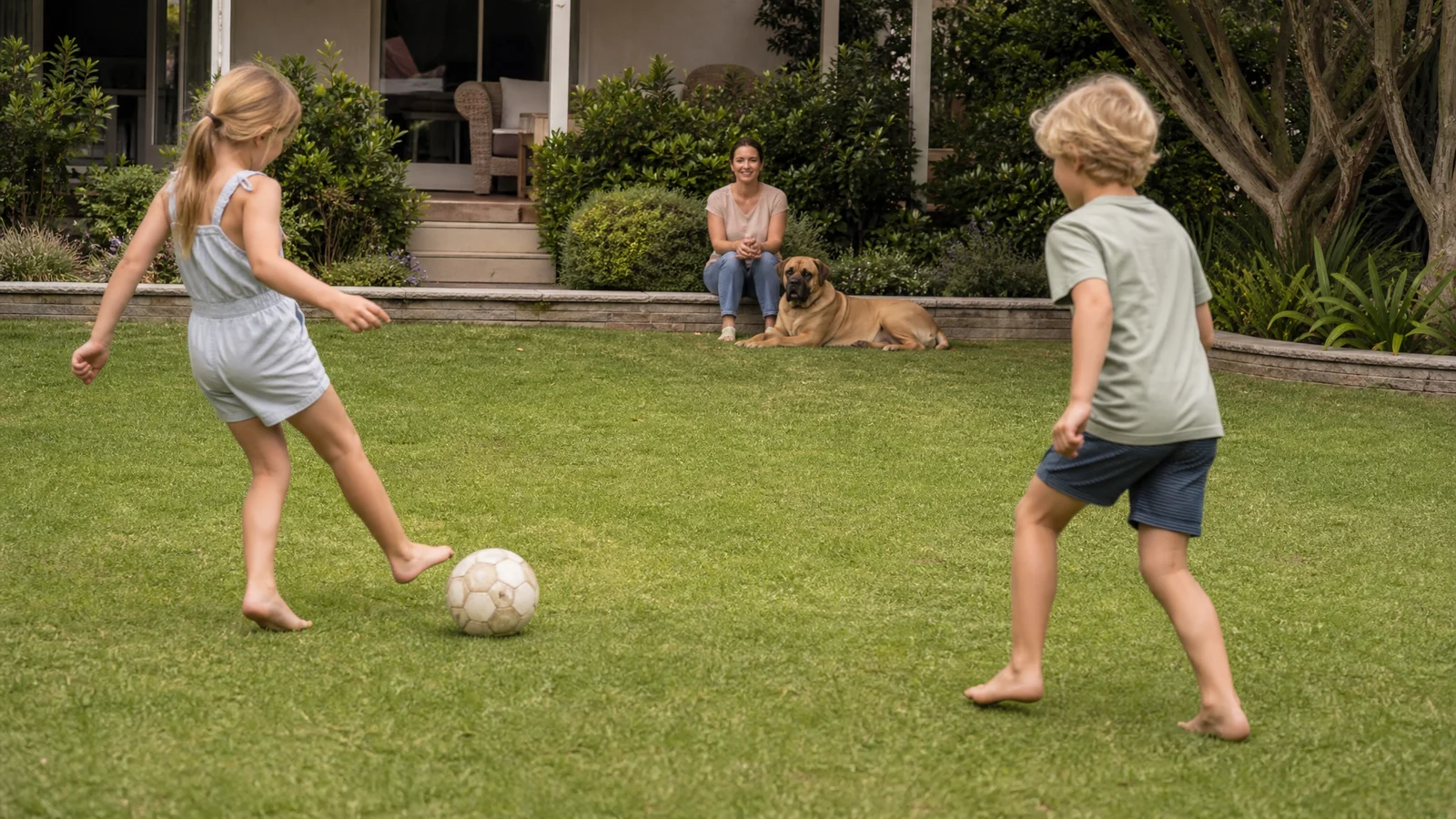
Yes, a Boerboel can be a good family dog, provided you socialize early and supervise every interaction with children and other dogs. The affection is not in doubt. What decides the outcome is that this breed was built to guard, and a guardian that never learns what ordinary life looks like will treat ordinary life as a threat.
That matters more here than with most breeds, because the dog is large, strong and watchful. Handled badly, you get a wary giant who cannot cope with the doorbell. Handled well, you get a steady, devoted companion who watches visitors calmly and settles when asked.
Read on for the farm history behind that temperament, honest ratings with kids and other dogs, a method for greeting guests, the case against dog parks, and a plan you can start tomorrow.
Farm Guardian Roots of the Boerboel
The Boerboel's ancestors were coveted as guardians against predators and intruders on the farms of South Africa. These were utilitarian farm dogs. The breed standard describes the structure, temperament and heart to work in the fields by day, protect at night, and still be trusted as a reliable and stable family companion.
The work was serious. These dogs were often the first line of defense against predators, and their agility and strength were used to run off or tangle with ferocious wildlife while protecting homesteads. Boerboels are guardians of home and family, and that phrase is the whole job description.
Now the skeptical part. The breed's public image swings between gentle giant and liability, and neither fits the evidence. The standard prizes calm, stable, confident composure, not hair-trigger aggression. In our view, the menacing reputation comes from dogs who were never taught what normal life looks like.
What Protective History Means for Socializing Today
In a living room, the farm job turns into vigilance. The breed scores 5 of 5 for watchdog and protective nature, the top of the scale. The standard says an approached Boerboel is calm and confident, at times self-assuredly aloof, and able to recognize a threat or lack thereof.

That last phrase is your training goal. The dog is born to evaluate. Your job is to supply enough calm, pleasant experience that they evaluate correctly.
Early socialization is a must, and it comes paired with structured, long-term obedience started young. Here is a piece of common advice worth rejecting: the idea that a sweet, pliant puppy will simply stay that way. Puppies are easygoing, and consistent training has to be well underway before that quality fades.
Start Within the Learning Window
Timing is on your side if you use it. Puppies are most receptive to learning about their surroundings from between 3 and 14 weeks old, so that is the window to begin. Puppy socialization classes can generally start at 7–8 weeks, once the puppy has had at least one set of vaccines 7 days before the first class and a first deworming. Ask your veterinarian to confirm the schedule, and keep regular checkups going.
This is general information. Check with your veterinarian before any medicine or diet change.
We specialize in Boerboel behavior and training, and the order we favor is calm first, contact second. This is not a beginner's breed, and it is kinder to say so now than after the dog is full grown.
Is a Boerboel Good With Children?
Mostly yes, with conditions. Breed ratings put affection with family at 5 of 5 and good with young children at 4 of 5. On that scale 3 means with supervision and 5 means good with children, so a 4 is strong but not a blank check. The breed standard calls the Boerboel loving with children and family, and some work as docile therapy dogs with a soft spot for children.
Ratings describe a breed's average, not your dog on a loud Saturday. Size is the first hazard, because a loving dog this big can flatten a toddler by leaning. The second is the guardian wiring. Shrieking, chasing and wrestling are exactly where a watchful dog can misjudge, so treat those moments as risky no matter how gentle your dog has been.
These rules hold for the dog's whole life:
- An adult stays within reach and actively watching whenever child and dog share space, not merely somewhere in the house.
- Use a gate or pen whenever no one can watch. Separation is management, not punishment.
- Children should give the dog space during meals, sleep and rest, and should never hug, climb on or grab at them.
- Build a reward-based go-away cue with treats, which shows the dog they may step away from a baby or child rather than feel cornered and end up growling or snapping.
- Let children join the rewards by tossing treats on an adult's signal, and end each session while the dog is still relaxed.
- Apply every rule to visiting children, who are the least predictable of all.
Notice what is missing: any expectation that the dog will tolerate whatever happens. A Boerboel should never have to.
Socializing a Boerboel to Meet Visitors and Strangers
On openness to strangers the breed lands at a middling 3 of 5, labeled ambivalent. The standard says Boerboels should be discerning and accepting of friendly strangers with proper introductions, although many remain reserved and aloof.
Common advice says a well-socialized dog loves everyone. Not this breed. Aim for polite indifference. A dog who notices a guest, relaxes and goes back to their mat has done everything you need. Reward-based training suits that goal, because food, toys or praise for calm behavior make calm behavior more likely again.
Try this sequence with a patient friend before real guests arrive:
- Before the guest enters, settle the dog on their mat, either on leash or behind a gate.
- Ring the bell or knock first and reward calm with the marker word yes and a treat.
- The guest enters, ignores the dog and sits down, with no eye contact and no reaching over the head.
- Reward every glance at the guest that is followed by a glance back at you.
- If the dog stays loose, the guest tosses a treat to the side and lets the dog choose whether to approach.
- End the visit with the dog settled, before any stiffness or staring appears.
If the dog tenses or gets wound up, a calm time-out behind the gate is enough. Then try again later with more distance.
Outdoors, the same logic applies. Strangers on a walk do not need to greet your dog. Reward a relaxed look and keep moving. Because of the breed's protective instinct, a Boerboel should never be allowed off leash, and that includes greetings.
Can Other Dogs Share a Boerboel's Space?
Sometimes, and only with planning. On the same scale the breed gets 2 of 5 with other dogs. The standard says an aggressive or belligerent attitude toward other dogs should not be faulted, and Boerboels do not take kindly to challenges from other dogs. That is a breed trait to manage, not a flaw to scold away.
Introductions on Neutral Ground
Start with parallel walks, both dogs moving in the same direction at a distance where yours can still take treats. Reward looking at you. Close the gap over several walks, only while both dogs stay loose.
Pick the practice partner carefully. A calm, steady adult dog teaches far more than an excitable youngster or a pushy one. Keep leashes loose, skip face-to-face greetings, and end while things are still going well.
Sharing a Home With Another Dog
Meet first on neutral ground, then keep the dogs separated by a gate for the first days. Feed them apart and pick up high-value chews and toys that could spark rivalry. Never leave them loose together unsupervised until they have a long record of calm, and even then, use gates when you are out.
Expect the dynamic to be tested again as your Boerboel matures, so keep your management habits in place after the honeymoon.
Why the Dog Park Is Out for Socializing
Visiting dog parks is not recommended for the breed, and we agree. A park combines off-leash strangers, unknown manners, little control over other owners and a dog who does not take kindly to challenges. That is a poor bet for any guardian breed.
Push back on the advice to let dogs work it out among themselves. One rude greeting at speed can teach a protective dog that other dogs are a problem, and that lesson may take months to undo. Every dog you meet there is a gamble you did not need to take.
You can socialize better without the gamble:
- Run parallel walks with a known, steady dog, which is the safest way to build comfortable dog-to-dog experience.
- Arrange leashed greetings with a friend's calm dog on neutral ground, with a clear exit plan.
- Join a reward-based class once vaccinations allow, where the setting is structured and handlers are present.
- Sit on a bench along a quiet path and reward calm while other dogs pass at a distance.
- Meet the brain's needs at home. The breed rates 4 of 5 for mental stimulation, so see our guide to exercise and brain games for ideas that tire the mind without any crowds.
A dog with their needs met at home is less likely to treat every new dog as an event.
A Fourteen-Day Socializing Plan
Use this plan as a starting framework and adjust the pace to your dog. Keep sessions short and stop while the dog is still doing well. If your puppy is under the vaccination window, keep outings controlled and ask your veterinarian what is safe.
| Days | Daily actions |
|---|---|
| One and two | Teach settle on a mat and the marker word yes. Reward calm moments around the house, especially when things get busy. |
| Three and four | Teach the go-away cue by tossing a treat away from you and rewarding the dog for walking off. Practice gate time with a chew so separation feels pleasant. |
| Five and six | Rehearse the doorbell with family members as stand-in guests. Reward calm, then a settle on the mat, leash on. |
| Seven and eight | Host one calm adult guest using the visitor sequence above. The guest ignores the dog and tosses treats to the side. End before tension. |
| Nine and ten | On leash walks, spot other dogs at a distance and reward looking at you. Add one parallel walk with a calm, familiar dog. |
| Eleven to fourteen | Run short, supervised sessions with a child using the rules above, gate ready. Then repeat your easiest wins and note what worked in a notebook. |
After day fourteen, do not stop. Keep the best exercises in your weekly routine, because a guardian breed needs a lifetime of rehearsal at being calm. The plan builds the habit, and the habit protects your family, your guests and the dog.
Book a regular veterinary checkup too, since pain or illness can change behavior. The main aim stays the same through every stage: teach a naturally watchful dog that ordinary life is safe, then supervise as if they are still learning.
 HealthHow to Muzzle Train a Boerboel for Calm Vet Visits
 BehaviorDoorbell Drama: Managing a Boerboel When Visitors Arrive
 BehaviorStop Destructive Chewing in a Boerboel