
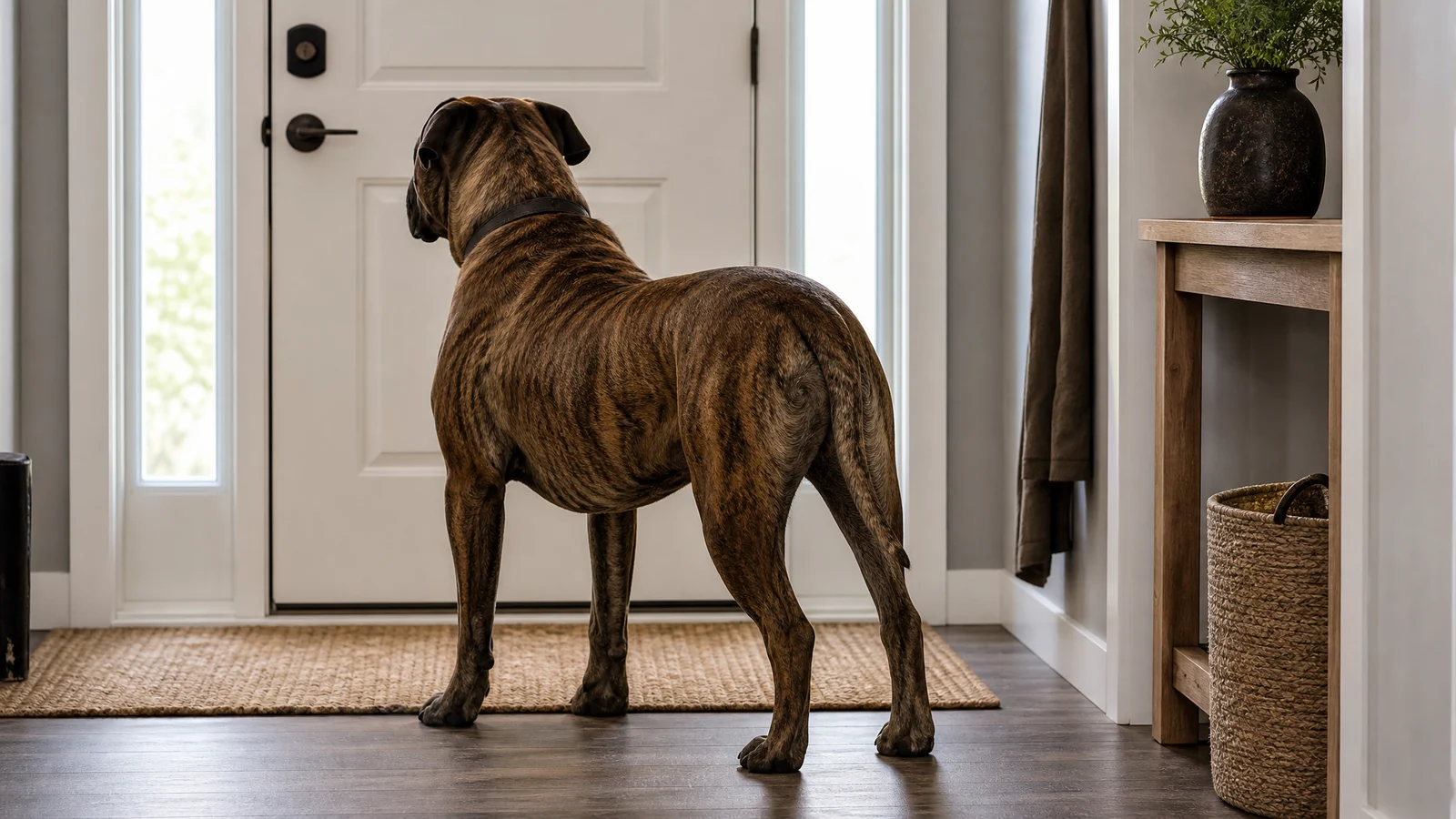
The breed standard describes a Boerboel who is calm, stable and confident, with the judgment to tell a real threat from a harmless one. The usual advice is to socialize early, train steadily and let that judgment grow. What households actually meet first is a loud doorway display, a big body planted between you and the door, and a tense reaction to every visitor.
So, are Boerboels aggressive? Guarding is not the same as aggression, but the drive is strong enough that poor handling can produce a dog who frightens guests and cannot relax. We specialize in Boerboel behavior and training, and we would rather you see that coming. This guide covers guarding in this breed, from its farm origins to life with a fully grown adult, with a hypothetical puppy and apartment followed step by step in between.
Boerboel Guarding Instinct
Watch a young Boerboel hear footsteps outside and you can see the job switch on: the head lifts, the body goes still, and a deep woof follows. Nobody taught that. The AKC rates the breed 5 of 5 for watchdog and protective nature, the vigilant end of its scale, and calls the Boerboel protective and territorial.
That vigilance is a trait to understand, not a fault to remove. It becomes a problem only when it has no direction, so most of this guide is about giving it some.
Farm Origins
The name is generally translated as farmer's dog. The breed came out of South Africa as a farm guardian, a first line of defense against predators. A dog built for that work does not switch it off at the front door.
The standard says the protective character is still evident today and much sought after. A second breed standard describes a dependable family guardian with the courage to protect if called upon and to work with their handler as a team.
Two details keep this in proportion. The breed is also intelligent, willing to please and loving with children and family, and it rates at the top for affection with family. The guarding is aimed at home and loved ones, not at the world in general.
What Calm Confidence Looks Like
According to the breed standard, a Boerboel who is approached is calm, stable and confident, at times showing a self-assured aloofness, and should recognize a threat or lack thereof. In practice that is a dog who notes a stranger, decides nothing is wrong and goes back to what they were doing. Aloof means uninterested, not unfriendly.
That dog is the result of raising, not a factory setting. Published ratings put openness to strangers in the middle, at ambivalent, and many Boerboels stay reserved with new people for life. Friendly strangers are accepted after proper introductions, and some dogs never go beyond polite distance.
Other dogs are a separate question. The breed rates low for getting along with them at 2 of 5, and the standard does not fault a belligerent attitude toward other dogs. That is why the dog park is no place to test your puppy's manners.
Example Boerboel Puppy at Home
For the rest of this guide we follow a typical setup. A ten-week Boerboel puppy comes home to a two-bedroom apartment where the front door opens straight into the living room, the hallway outside is shared with neighbors, and a big window overlooks the street.

This apartment is a useful test because it packs every guarding trigger close together. Footsteps, doorbells, elevator dings and delivery drivers all happen within a few feet of the puppy, many times a day. A house with a long driveway would spread those out. Here they arrive at once, so routines matter more and results show sooner.
The people in the example are a couple who have committed to structured, long-term training. That commitment matters, because this is not a breed for a novice owner who plans to wing it. Here is the setup we will follow:
- The puppy sleeps in a crate in the bedroom and rests in a gated area of the living room during the day.
- The day runs in a fixed order: potty trip, breakfast used for training, a leashed walk, a midday rest, play and a brain game, an evening walk, then a quiet wind-down.
- Visitors are a friend or relative on weekends, a delivery driver most days and a neighbor with a dog down the hall.
- Every person in the home gives identical cues and follows one set of door rules.
The full month-by-month plan for this age is in our Boerboel puppy training timeline. Here we follow only the guarding thread.
Guarding in the First Months
In the first weeks, the example puppy mostly eats, sleeps and follows the couple from room to room. This easygoing phase is where many households relax. Puppies are pliant, and an inexperienced owner may assume they will stay that way, when consistent training has to be well underway before those qualities fade.
So the quiet start is the time to begin the work described in our guide to starting Boerboel obedience training, not a reason to wait. The changes below arrive gradually, and each one is easier to shape while it is still small.
First Alert Barks
A sound in the hallway produces the first surprised woof. Respond with a calm acknowledgment, a treat for quiet and a sit or a trip to the mat, not scolding. Barking is rated as occasional for the breed, so a puppy who sounds off is doing something ordinary. What you reward now becomes the habit of the adult.
Watching the Door
As confidence grows, the puppy begins posting themselves at the entrance, sometimes standing between you and the door. In a small apartment that gets rehearsed many times a day.
Some advice says to let them keep watch because it keeps them busy. With this drive, a post at the door tends to become a fixed habit that gets harder to change every month. Offer a better place to rest and watch from, and reward them for using it.
Reactions to Guests
Guests now bring a louder display: barking, a stiff stance, perhaps a body block at the door. Some puppies calm as soon as the visitor sits, and others stay watchful and reserved for the whole visit. Both are within normal. What matters is how quickly they recover and whether they can be called away.
Another common piece of advice says the dog will grow out of it. For this breed, confidence and protectiveness tend to increase with maturity, so plan for more, not less.
Where Guarding Crosses Over
In the example, a weekend visitor stands up quickly, and the now larger puppy goes rigid at the door and does not respond to their name. That moment tells you more than any barking fit. Normal guarding is loud but recoverable, rising and then settling. Trouble is guarding that stays rigid, ignores you, or spreads to food, toys and spaces.
Warning Signs
These are the signals to watch for, roughly from early to serious:
- A hard stare with a still, stiff body and weight shifted forward.
- A closed mouth and frozen posture just before barking or lunging.
- Ignoring treats, cues and their own name while a person is nearby.
- Pacing the door or window and being unable to settle after the guest leaves.
- Freezing over a bowl, chew or favorite spot when someone walks near.
- A growl directed at a person.
Treat a growl as information. Growls are warnings, so calmly move away and show the dog they do not need to escalate.
Common Triggers
In the example apartment the triggers are predictable: the doorbell, hallway footsteps, a visitor leaning over the puppy, a person reaching for a chew, and the neighbor's dog passing at close range. Because of the protective instinct, a Boerboel should never be allowed off leash, and that includes the hallway and the building entrance.
Fear can look like guarding, too. A frightened dog usually backs away, yet may turn aggressive when cornered or trapped. Never let a visitor pin your puppy in a corner or crowd them against the door.
When a Professional Is Needed
Call for help early if the puppy growls or snaps at people, if stiffness does not ease with distance and treats, if resource guarding is getting worse, or if you feel unable to manage the dog's size and strength. Choose a trainer or behavior consultant who uses reward-based methods and has worked with large guardian breeds.
Book a vet visit as well, since pain can change behavior. Regular check-ups belong in any plan for a dog this size, and if their temperament shifts suddenly, go sooner.
Managing Guarding at Home
In the example apartment, the biggest gains come from changing the front-door routine, not from changing the puppy. Every rehearsal of barking and body blocking makes the next one stronger, so management comes first and training builds on top of it. The tools below are in the order the couple would set them up.
Door Routines
Run the same sequence every time anyone comes or goes:
- Put a gate or a leash between the puppy and the door before anything opens.
- When the bell sounds, send the puppy to the settle spot and reward as soon as they arrive.
- Open the door only once the puppy is calm. If they pop up, close it again and reset.
- Practice the bell with a helper many times with no real guest involved.
- When leaving, wait for a sit at the threshold, then walk on a loose leash. If it tightens, stop walking and wait for the pulling to stop.
A Settle Spot
Pick a bed or mat away from the door, ideally out of sight of it, and make it the best place in the apartment. Reward lying down on it, add a chew, and lengthen the time slowly. Then use it every time the bell rings.
If the puppy cannot calm down, a quiet break in the gated area is a gentle reset. Keep it low-key, with no scolding.
Controlled Greetings
Greetings are where reserved, aloof dogs are most often pushed too far. Give visitors a short checklist:
- Text before arriving, then ignore the puppy for the first few minutes.
- Skip looming, leaning over, hugging or reaching for the head.
- Let the puppy choose to approach, and toss a treat to the side instead of handing it over.
- End the greeting while the puppy is still relaxed.
- Never insist on petting. A dog who stays aloof is behaving as the standard describes.
Rewarding Calm Choices
Mark and reward the moments you want more of: looking at a trigger and then back at you, lying down when the hallway gets noisy, ignoring a sound. Life rewards count too, since the door opens or the walk starts only after calm behavior.
Mental work helps, because the breed rates 4 of 5 for mental stimulation needs. For ideas, see our activity article on Boerboel exercise and brain games. Do not rely on exhaustion alone, though. A tired guard is still a guard.
Living With a Guarding Boerboel
By adulthood the example dog is large, strong and watchful, and the front door is still the busiest spot in the apartment. Guests still get a long look. The difference is that the dog now checks in with their people before deciding anything, and the display is shorter and quieter.
Confidence and protectiveness tend to increase with maturity, so the stretch from adolescence into young adulthood is usually when guarding feels strongest. Dogs vary, so watch yours instead of the calendar. Expect to refresh settle, greeting and door routines more often during that time, and keep up the structured obedience work you started when the dog was young.
Some things never change: no off-leash freedom, gates and leashes at doors, proper introductions for new people, no dog parks, and regular vet visits. These are not signs of a problem dog. They are the normal upkeep of a breed built to guard.
Guarding never disappears, but a well-raised Boerboel becomes steadier and more discerning with consistent management through adulthood and into old age. Expect loud displays to shorten, recovery to speed up, and the calm, self-assured aloofness of the standard to settle in. In the senior years, keep the routines and keep seeing the vet, since a sudden change in behavior can be a sign of pain.
 Training basicsCrate Training a Boerboel and Preventing Separation Anxiety
 Exercise and jobsBoerboel Exercise Needs and Brain Games for a Working Breed
 Training basicsHow to Potty Train a Boerboel Puppy