
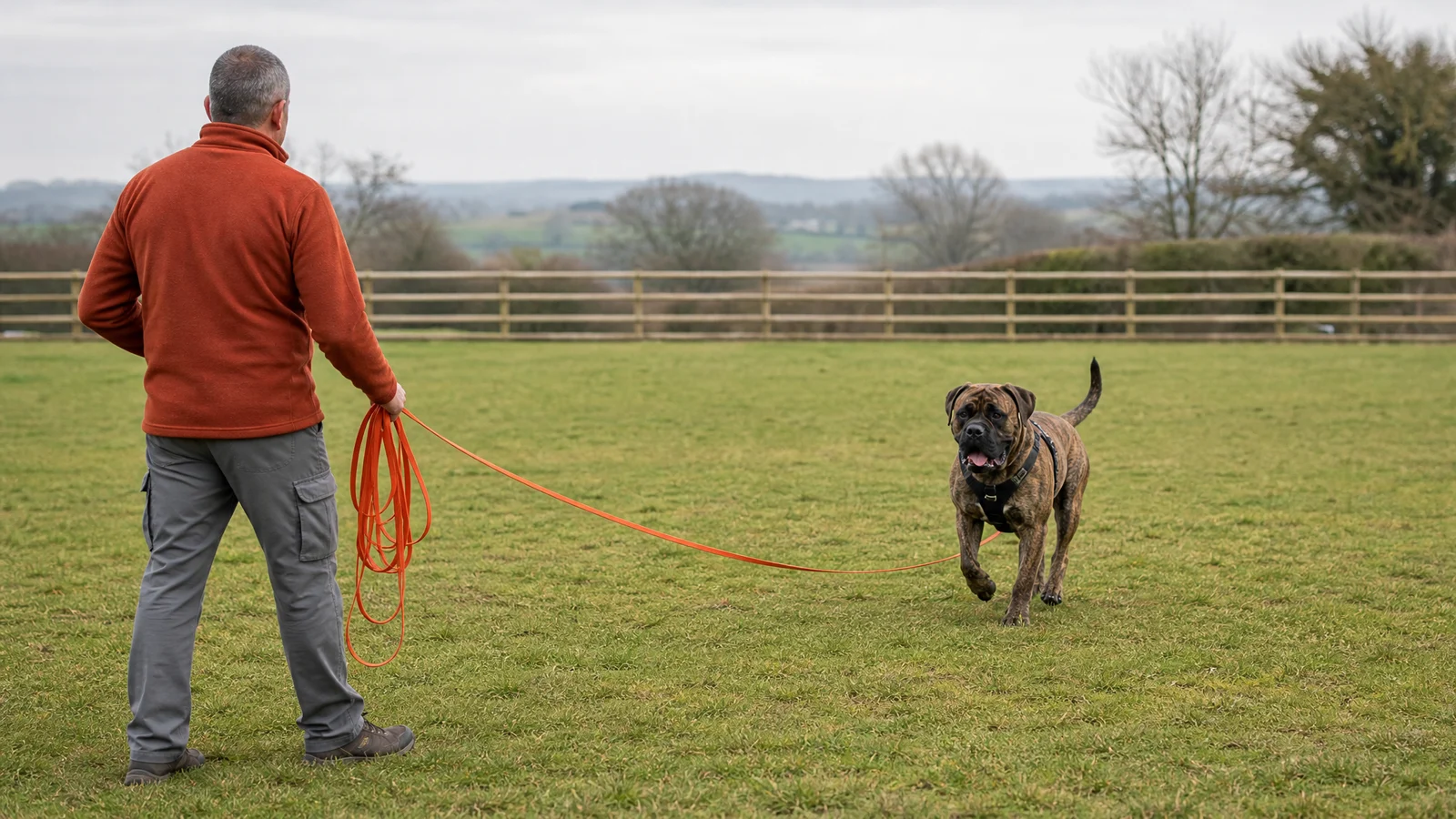
Start recall games indoors as soon as the puppy has settled into the house. The long line comes out when the hallway return is quick and happy, and real reliability takes many months of steady work after that. Even then, it applies only inside secure areas, for the whole of the dog's life.
This article looks at recall for a Boerboel who will never walk off leash in public. You will be able to teach a glad return on a long line in a fenced yard, stretch it with distance and distractions, and repair a missed call without losing ground. Done well, you get a large, protective dog who moves freely and still turns toward you when you call. Done badly, you get a heavy dog who has decided that answering you is optional.
Recall Timeline for a Boerboel Puppy
We plan recall in stages rather than by the calendar, because readiness depends on confidence and focus as much as on age. The order is the same for every dog, and this table shows what belongs where.
| Stage | What you are doing | What to expect |
|---|---|---|
| From about eight weeks | Short indoor recall games with tasty treats | The puppy arrives happily because nothing else in the room beats being near you |
| Early months | Long line in a fenced yard | Quick returns in quiet settings, with some drifting toward good smells |
| Adolescence | Longer distances, one new distraction at a time | Slower, choosier responses as confidence grows, so you step back often |
| Adulthood | Regular upkeep and occasional refreshers | A dependable return in secure spaces, with the leash in place in public |
The early start matters because Boerboel puppies are easygoing and pliant, and owners can mistake that for a permanent trait. Those qualities fade as the puppy matures, so consistent training has to be well underway before they do. Starting indoors costs a few minutes a day.
Starting late costs more. You meet a larger, more independent dog who has already learned that walking away works. Our guide to starting training early explains the wider window before the puppy phase fades.
Adolescence is where a patient plan pays off. Responses that were instant can turn slow or selective, and that is a normal phase, not a failure. You shorten the line, raise the value of the reward and go back one step. A planner accepts this dip in advance instead of reading it as a verdict on the dog.
Why Does a Boerboel Need a Long Line?
The reason is temperament. The breed standard says the protective character of the Boerboel is still evident today and much sought after. Because of that instinct, the AKC advises that a Boerboel should never be allowed off leash. We build recall around that guidance instead of working against it.
The breed is meant to judge whether a stranger is a threat, and a dog who is making that judgment is at their least responsive. A recall that works perfectly at home can fail the moment a person, a dog or a noise across the road takes over their attention. With a heavy, powerful dog, the cost of that failure is far higher than with most breeds.
Common advice says to build recall until it is reliable and then graduate to off-leash walks. For this breed we disagree. Recall is not the road to off-leash freedom here. It is a safety skill and a way to share a relaxed life inside secure boundaries.
The line is what makes that life possible. A long training line gives your dog some freedom without the run of the whole property. They can sniff, trot and explore, and you keep a hand on how each moment ends. For a Boerboel, that arrangement suits the learning stage and every stage after it.
Line, Harness and Fenced Space for Recall
The equipment is simple, but each choice changes how pleasant the work is for both of you. The location matters even more than the gear, because the line is only a backup and the fence is what keeps everyone safe.
Choosing the Gear
Look for a line light enough not to drag on the dog and strong enough for a large, powerful breed. Gather these before the first outdoor session:
- A soft, grippable line that is easy on your hands and does not tangle badly, long enough that your dog can wander well away while you still manage it comfortably.
- A well-fitted harness that the line clips to, rechecked often as a growing puppy changes shape.
- Gloves, if you want them, since a moving line can burn bare hands.
- A treat pouch of small, soft, high-value treats you can hand over in a second.
Keep regular vet visits going through the growing months. A puppy's body changes quickly, and soreness can show up as a reluctance to run to you.
Choosing the Location
Pick a space with a secure boundary all the way around. A fenced yard is the obvious choice, and an enclosed field you have to yourself works too. Dog parks are the wrong setting, since Boerboels do not take kindly to challenges from other dogs and the place is packed with triggers.
Walk the fence line for gaps before each session, and schedule early practice for quiet times when neighbors are not passing. You are building a habit, so make the practice setting easy.
Rewarding Every Recall Indoors
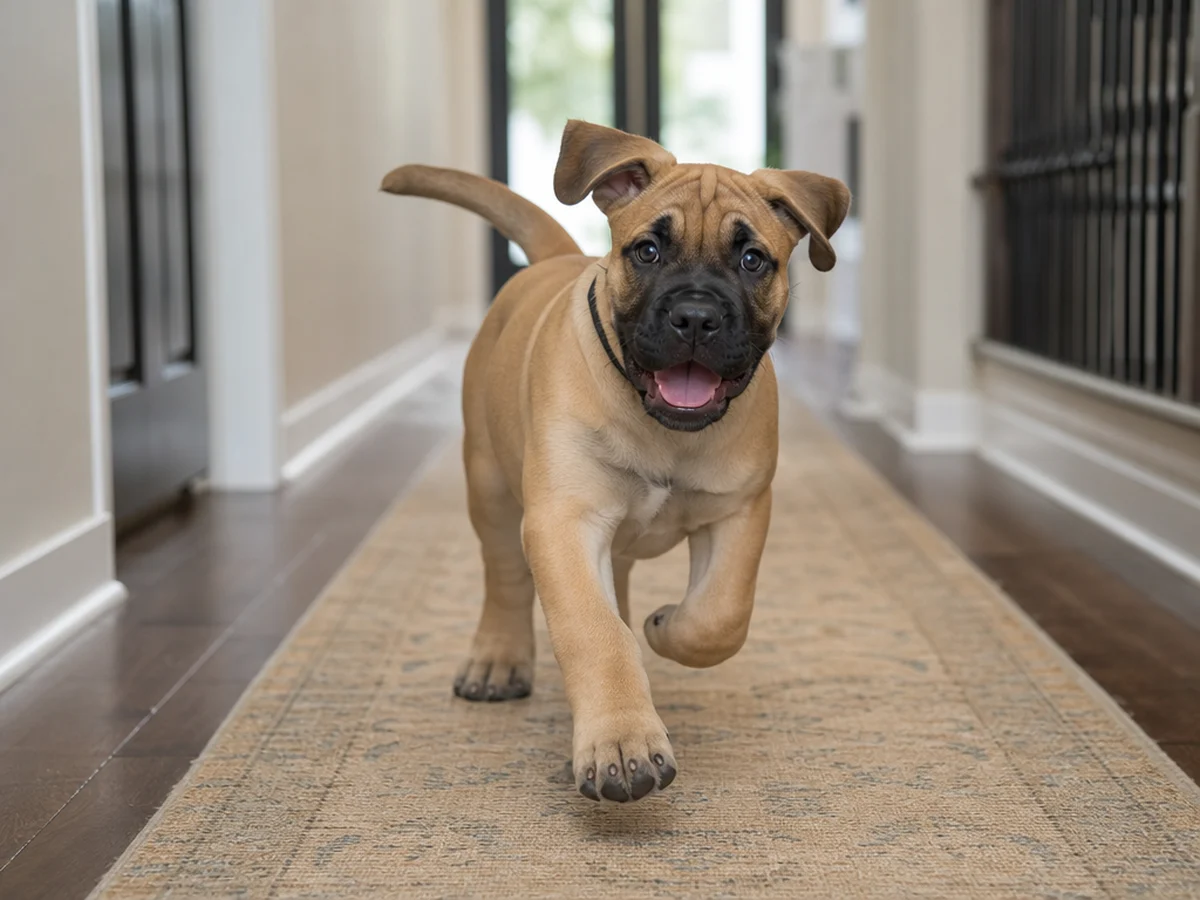
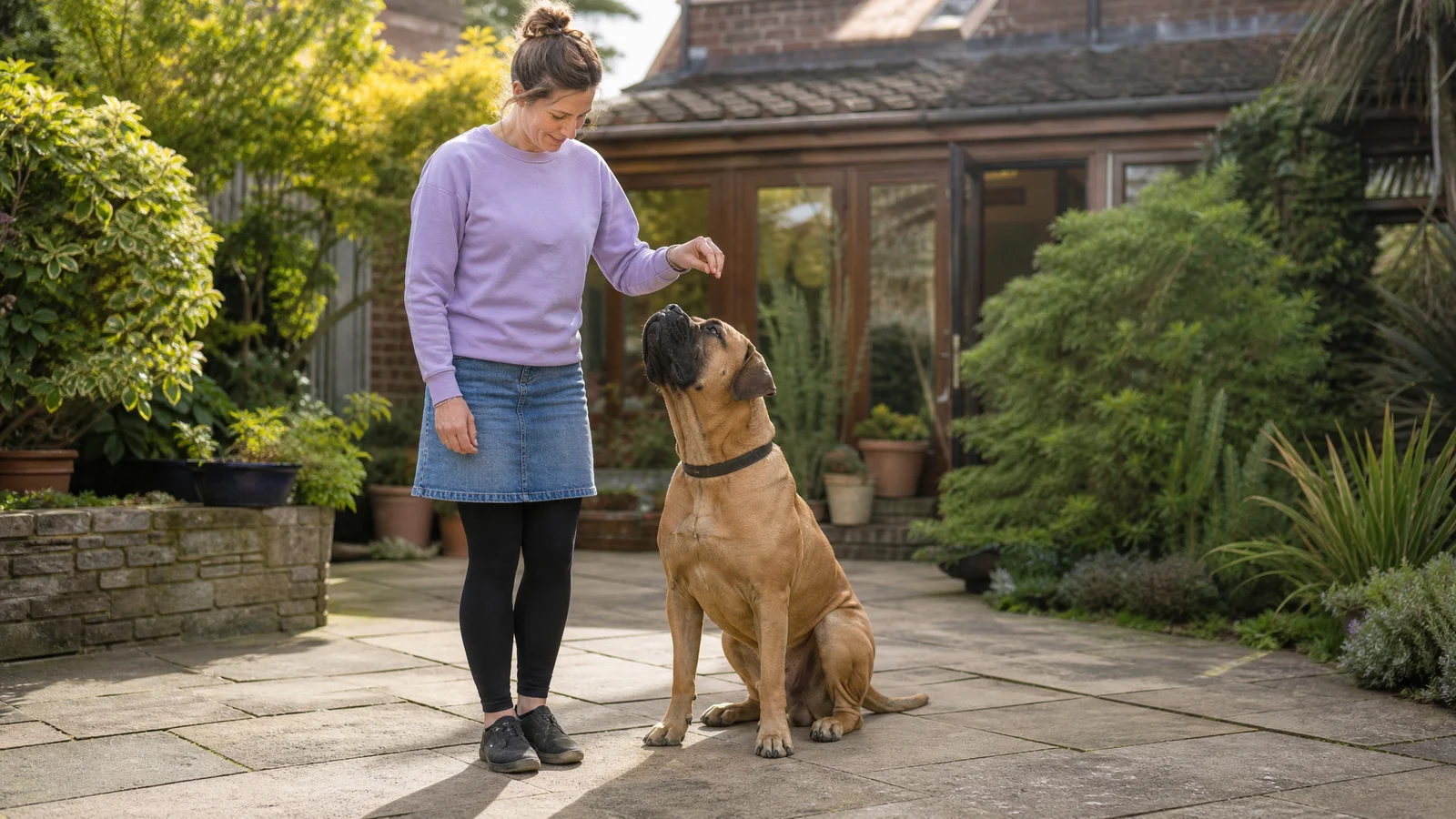
Stage one happens in a hallway or living room with no line at all. The room does the managing and the treats do the teaching. Your aim is for the cue word to become a promise that something wonderful is about to happen.
- Choose a cue word, such as "Here," and use it only for recall. Say it once rather than repeating it.
- Stand a few steps from your puppy, say the cue in a happy voice and show a treat.
- The instant the puppy turns toward you, say your marker word, then reward when they arrive.
- Add a gentle touch to the harness before the treat, so that being held predicts something good.
- Release with a cheerful word and let the puppy go back to what they were doing.
That last step is the one people skip. If coming to you always ends the fun, the dog learns to avoid you. If coming to you leads to a treat and then more play, you become the start of good things.
Practice in different rooms and when the puppy is mildly busy, such as nosing a toy. Stop each session early, so the puppy always wants a little more. Early habits of coming gladly are cheaper to build now than to repair in a grown dog with strong protective instincts.
Recall also pairs well with the sit, down and stay basics, since a dog who can wait calmly is easier to call from a distance. Both skills benefit from the same steady release cue.
Taking the Boerboel's Recall Outside on the Line
Stage two moves the same game to the fenced yard, with the long line clipped to the harness. The rule is to call while the dog is moving, because a dog already heading toward the end of the line is practicing the exact moment you want to be ready for.
Handling the Line
Hold the line loosely and let it trail or slide through your hand. Your job is to keep it from tangling, not to steer or stop the dog. If they reach the end, walk toward them and call from there.
Dogs tend to pull when they are excited or desperate to explore, and some learn young that pulling is what gets them forward. A loose line keeps that habit from forming. Our walkthrough on loose-leash walking covers the on-leash side of the same skill.
Rewarding the Return
Let the dog sniff and wander, then call a single time. Say your marker word as they swing toward you and deliver the treat at your feet. Use the best treats you own at this stage, because the yard is far more interesting than the hallway.
Vary the payment. Sometimes it is a handful of treats in a row, sometimes a game of tug and sometimes a cheerful release to go and sniff again. That last one is a life reward, and it teaches that coming to you opens up the yard instead of closing it.
How Far Can the Recall Line Stretch?
Gradually, and only as far as the dog's success allows. We lengthen the line in small steps and shorten it whenever returns slow down. The line is not a graduation certificate. It is a dial you turn up and down depending on how the dog is doing.
Raise the difficulty one way at a time. Change only one variable per session.
- Add distance first, while the yard is quiet and the dog is relaxed.
- Add time next, by waiting longer before you call, so the dog is deeper into sniffing.
- Combine the two only after each works alone, and still change nothing else.
The signal to shorten is simple. If the dog hesitates, arrives slowly or needs a second call, go back to the distance where they last succeeded and do a few easy repetitions.
Expect to drop back several times between now and adulthood. A step back is cheap if you take it early, and expensive if you wait until the dog has spent a week practicing ignoring you.
Adding Distractions Without Losing Recall
Stage three brings in the real world, but still on the line and still inside a secure area. Change one thing at a time so you can tell what caused a problem. Good additions, one by one, include a family member walking past, a new smell such as a scented toy, a mild noise from the house and a calm visitor standing at a distance.
Boerboels are watchful by nature, so be thoughtful about people. Plan introductions in advance, and have the visitor ignore the dog while you practice. Some dogs stay reserved with strangers, and that is part of the breed. Never use recall to push a dog toward someone they are unsure about.
Repairing a Missed Recall
Sooner or later the dog will not come. Do not repeat the cue louder. Calmly gather the line, walk to the dog and either lead them a few steps with a treat at their nose or set up an easy call from close range. Reward, then end on a win.
Afterward, ask what changed. The distraction may have been too strong, the distance too great or the reward too dull. Reward-based training does not mean the dog may do anything they like. Structure and routine matter, taught without fear or pain, and a calm reset with easier practice is that structure at work.
A Boerboel's Long-Term Recall Limits
Expect recall to grow steadily over many months and become dependable in secure spaces such as your yard, a fenced field and your own home. A well-trained Boerboel will turn away from a smell, a sound or a distant person and come back to you for a reward. That improves daily life, makes visitors and chores easier and gives you a way to interrupt trouble before it starts.
It does not replace the leash or the fence. The same protective instinct that defines the breed means even a good recall can fail in a tense or exciting moment, and a heavy dog out of reach is a risk to themselves and others. Keep the leash on in public for life, and treat the fence and the line as the real safety system, with recall as a valued extra layer inside it.
Plan for upkeep as part of normal life. Practice a few easy recalls every week, run a refresher after any lapse and go back to the line after an illness, a move or a change in routine. Keep regular vet visits too, because pain or stiffness can make a dog slower to come. If you treat recall as a lifelong habit rather than a one-time project, your Boerboel will keep turning toward you gladly, and you will both enjoy the freedom the secure spaces can offer.
 CareTeaching Your Boerboel to Stand for Handling and Examination
 Training basicsImpulse Control Games: Wait, Leave It and Settle
 Training basicsSit, Down, Stay: Reward-Based Basics for a 150-Pound Dog