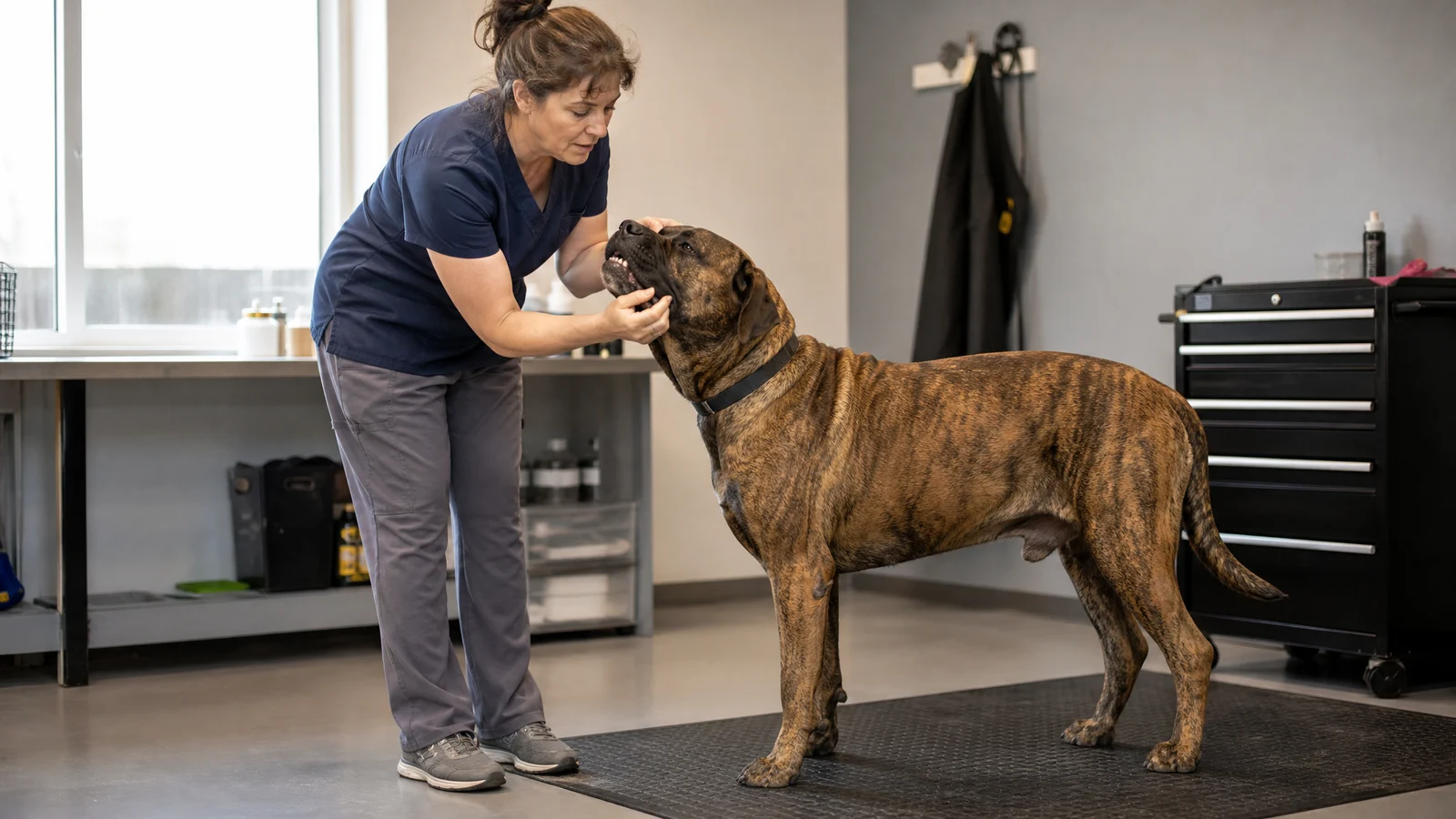
How do you get a Boerboel to let you touch their feet and mouth? A common suggestion is to persist until the dog stops resisting, but that plan falls short with a strong, confident dog. A Boerboel can outlast almost anyone, and they remember how the contest went, so the next nail trim or exam starts from a worse place.
The stakes are real. Grooming, veterinary care and the show ring all depend on a dog who accepts hands on every part of the body. A dog who learns that touch is predictable and rewarded stays easy to care for across a lifetime, while a dog who dreads it becomes a risk at every appointment.
In this article, we'll go through the small-step method, the calm stand that grooming depends on, how long to practice, why paws bother some dogs, and separate plans for feet and mouth. Our team specializes in Boerboel behavior and training, and the lesson repeats: tiny steps, generously paid.
A Boerboel Learns Handling in Small Steps
The AKC standard says Boerboels shown in competition should be trained to allow examination, and that expectation shapes how handling is taught at home. It also points to the method. Nobody can force a powerful, confident dog to accept hands on every part of the body, so the only workable route is a dog who agrees.
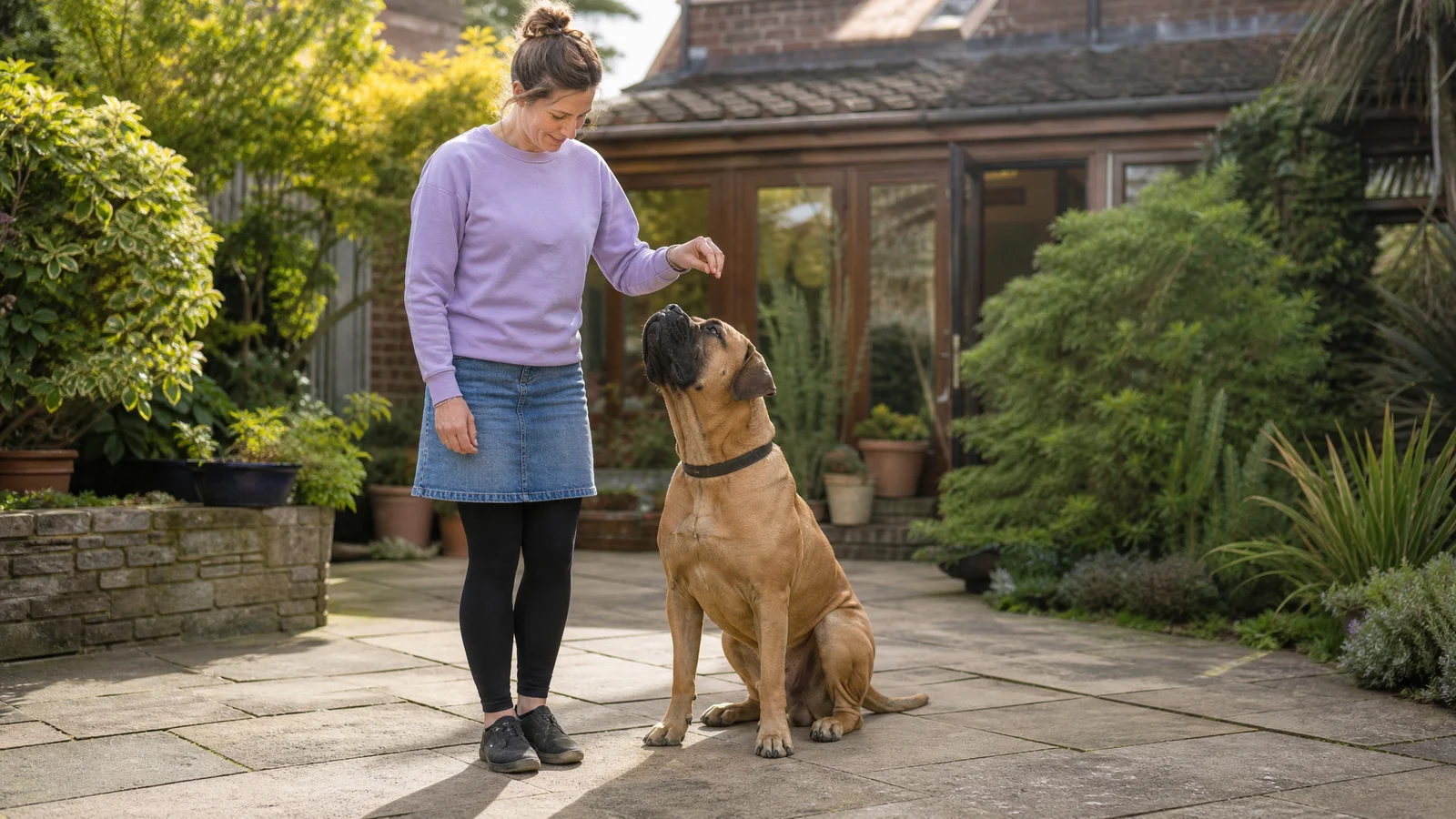
Agreement comes from small steps, much as a child learns to read: letters come before words, and words before sentences. Decide on the finished behavior, such as standing calmly while a stranger runs a hand over the whole body, then split it into pieces so small that your dog succeeds almost every time. These clicker training basics describe the same idea, with each small step marked and rewarded in sequence.
Build One Touch at a Time
One touch on the shoulder is a piece, and a hand sliding down a leg is another. Each piece earns a marker and a treat before the next is added. The marker is a signal word, for example yes, spoken the instant your dog does what you wanted, and it tells them food is coming. Boerboels are intelligent and want to please, so most grasp this game quickly.
A rushed step rarely starts a fight with a breed this calm and self-assured. It produces a dog who quietly walks away. If your Boerboel turns their head, shifts their weight or leaves, the request exceeded their comfort, so repeat an easier touch they already welcome, reward it well and try a smaller version of the next one.
Grooming Starts With a Calm Stand
Before you pick up a brush, a nail grinder or a toothbrush, teach the position they all depend on. A stand means your dog keeps their feet planted and their body still while you work. Brushing, nail care and veterinary exams all happen in that position, and it is far easier to build while your dog is relaxed than in the middle of a task.
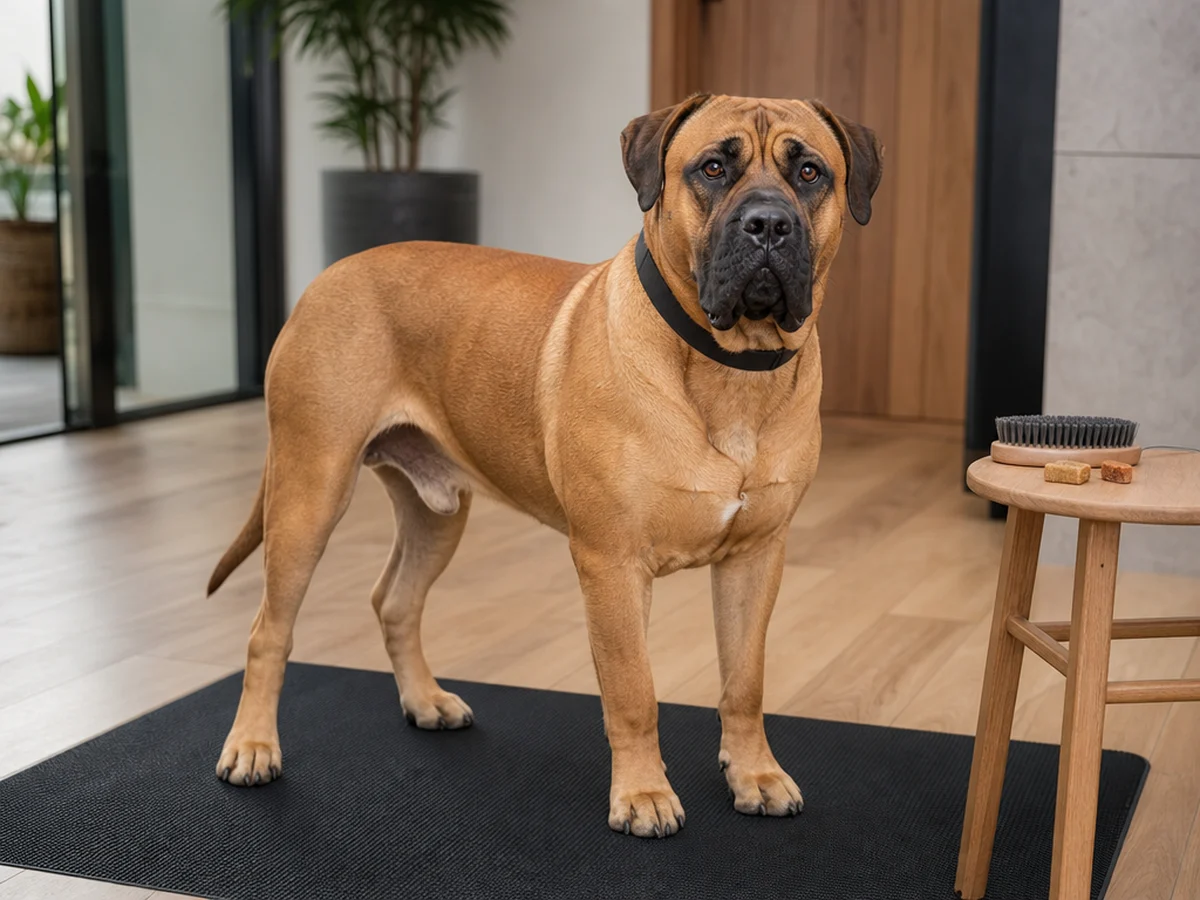
Use a non-slip mat on the floor of a quiet room, since a dog this size is usually handled at floor level. Then follow these steps.
- From a sit, draw a treat forward at nose level until your dog rises into a stand.
- Mark the moment their feet stop moving, and feed low, beside the front legs, so they never need to step toward your hand.
- Pause briefly before you mark, and add a little more time on each repetition.
- Say a release word such as free to end the stand, so it finishes on your signal instead of because your dog drifted away.
A steady stand matters more in a Boerboel than in a small breed. This is a large, muscular dog, and when they shift their weight while you work on a back foot or lift a lip, you feel it through your whole body. A dog who already knows that holding still pays well is much easier to groom than one you have to prop in place.
The breed is described as calm, stable and confident, and a relaxed stand is that composure at work. Add touch only after the stand holds without effort, beginning with a flat hand resting on the shoulder.
How Long Should a Grooming Practice Session Run?
Short and frequent works better than long and rare. Keep each session brief, repeat it through the day when your schedule allows, and let your dog's mood decide when it ends. A dog who leaves wanting more returns eagerly, while a dog worn out by repetition starts to avoid the mat.
Boerboels are quick learners, and that cuts both ways. They master a step fast, then tire of drilling it, and a bored large dog tends to wander off rather than protest. Build each session from a handful of repetitions, work on one body area only, and end on an easy one with your release word so the last memory is success.
Watch for signs that the session should stop. End when you see any of these changes.
- Your dog turns away or keeps stepping out of the stand even though the task is easy.
- They snatch treats roughly or stop taking them.
- Their body stiffens, their eyes harden or their mouth closes tight as your hand approaches.
- They hunt for another activity, such as sniffing the floor or heading for the door.
Any one of these is your cue to ask for something easy, reward it and finish. Next time, start a step lower, and consider whether the room, the time of day or a hurried mood on your side played a part. Stopping early is not giving in. It protects the progress you have already paid for.
Reward Each Grooming Touch
The goal is a dog who feels a hand and thinks of food. You get there by paying for every accepted touch, one at a time, always in the same order: touch, marker, treat. Say the marker as your hand lands, not after you have pulled it away, so your dog knows exactly what earned the reward.
Build the Touch Sequence
Start with broad, easy contact on the shoulder and back. Once your dog accepts touch all over, perhaps even leaning into your hand, you can move on to handling sensitive areas. Work from the ears to the lips, then the paws and tail. Slow, firm strokes usually feel better to a big dog than light tickling, and moving in the same order each time tells them what comes next.
Vary what you pay with. Soft treats are the workhorse, but calm praise, a short game afterward or a favorite chew all count, and the hardest steps deserve the best food. Let your Boerboel opt out at any point. If they step away, give them room and restart a step lower, because a protective, territorial dog who feels cornered has very few choices left.
Introducing Groomers and Vets
Strangers need the same approach. The UKC standard describes a Boerboel who should be discerning and accepting of friendly strangers with proper introductions, although many remain reserved and aloof. Have a groomer or vet technician toss treats from a distance first, and let your dog decide when hands are welcome.
Ask the newcomer to touch only the shoulder at first and to stop the moment your dog looks away. Bring your own treats so the payoff is one your dog already trusts. A stranger who moves slowly and pays well becomes part of the routine, and your dog learns that new hands predict the same good things yours do.
Why Does a Boerboel Dislike Paw Touching?
Many dogs object to having their feet handled, and Boerboels are no exception. The reasons are practical, and knowing them tells you how slowly to go. Feet carry weight and gather a great deal of sensation, so lifting one can feel startling.
In a heavy dog, raising one foot pushes a large share of body weight onto the other legs, and that can feel unsteady. The standard calls this the most agile of the molosser breeds, and a dog built for quick, buoyant movement may dislike having a foot pinned. Some dogs also carry a memory of a rushed trim or a sudden grab, and one bad experience can linger.
If your dog pulls the foot away, loosen your hand and treat it as information that the step was too large. A strong dog who learns that feet get held no matter what has a reason to defend them more firmly next time.
Go slower by shrinking the target. Touch the elbow, then the forearm, then the wrist, marking and treating each. Move down the leg only while your dog stays loose, and let a touch on the paw come well before any lift. If a foot suddenly seems tender, mention it at your next regular vet visit, since pain can look like stubbornness.
Grooming Paws and Mouth Separately
Feet and mouth are two different skills, and each needs its own progression. Progress on one says nothing about the other, since a dog who happily lets you hold a paw may still tense when a hand moves near their lips. Each progression moves through touch, lift or lip raise, and hold.
The Paw Progression
First, your dog accepts a hand resting on the foot. Then they allow it to rise for a moment, and finally they let you hold it while you handle the toes and pads. That last position is the one nail work needs, so reward at every stage and move up only when your dog is loose at the one below.
Introduce nail tools long before they meet a nail. Show the clippers or grinder and treat, touch the tool to the paw and treat, then run a grinder across the room so the sound predicts food. When you finally trim, take a single nail or even part of one, and finish on a good note.
The Mouth Progression
The mouth is one of the most sensitive areas to handle, and in a powerful breed it deserves the most patience. Begin outside it, stroking the muzzle and cheek with a mark and a treat. Then raise a lip at the side for a glimpse of teeth, and later add a short hold while your dog stays calm.
Keep your fingers still rather than poking around, and let your dog open for a treat instead of working at the jaws. A vet or judge will want to see the teeth and gums, so this work pays off at every exam. Train each progression in its own session, or finish one with an easy win before starting the other, so worry about one area does not leak into the next.
Daily Grooming Keeps the Boerboel Steady
Tolerance fades without practice, and rebuilding trust after a long gap costs far more effort than a few moments each day. Fold the work into ordinary life. Run a hand down the legs while your dog waits for dinner, lift a lip after a walk, or brush a shoulder during a quiet evening, so handling never becomes a special event to dread.
Start early and keep going. Boerboel puppies are easygoing and pliant, and inexperienced owners often assume that stays true, but consistent training has to be established while that gentle phase lasts. Daily handling also gives you a baseline, so new lumps, sore spots or changes in how they stand show up sooner and can go to your veterinarian at regular visits.
As your dog gets steadier, related questions tend to follow, and our other guides pick them up. The linked guides cover those next steps.
- Where should training begin while the puppy phase lasts? Our guide to starting Boerboel training early lays out the first steps.
- Is the breed as easy to learn from as they look? The FAQ on how trainable Boerboels are explains temperament and what to expect.
- What does the same patient rhythm look like with a young puppy? See potty training a puppy for a reward-first routine at home.
- What if an exam may need a muzzle? Begin muzzle training well ahead of time so it feels familiar.
Every one of these questions has the same answer for this breed. A Boerboel is big, strong, confident and protective, so you will never win by pushing, and you do not need to. Teach a calm stand, take one small step at a time, mark it and pay for it, and handling becomes something your dog expects to go well, whether the hands belong to you, a groomer, a vet or a judge.
 Training basicsImpulse Control Games: Wait, Leave It and Settle
 Training basicsSit, Down, Stay: Reward-Based Basics for a 150-Pound Dog
 Training basicsThe Mat Cue: Teaching a Calm Boerboel to Settle on Command