

You teach a Boerboel to settle by rewarding them for lying on a mat, over and over, until the mat itself becomes the cue and the dog heads there on their own. A spoken word can be added later, once the behavior is already dependable.
The breed suits this well. The breed standard prizes calm, stable and confident composure, and energy sits at a moderate 3 of 5, so a Boerboel can switch off without being exhausted first. A vigilant dog with no assignment will invent one, and the front door is the usual pick. Poorly handled, that becomes a dog who patrols every sound. Done right, you get a big, steady companion who rests through your dinner.
Below, you'll find the rewards that pay a settling dog, the gear a heavy dog needs, and the spaces to practice in, including daily routines for meals and doorbells, fixes for common setbacks, and the signs that call for a professional.
Mat Training Rewards
Everything in this method rests on what the dog earns for lying down. In our experience with this breed, a dog rated 4 of 5 for trainability picks up the mat quickly when the pay is good and the delivery is dull. Three decisions matter. What you pay with, how you hand it over, and how you fade it.
Food Rewards
Choose small, soft treats that go down in one bite, because a big dog crunching a biscuit is not settling. Before you ask for anything, link your marker word or clicker to food. Pairing a marker with food means sounding it and then feeding within 3 seconds, in a calm, quiet place, repeated several times until the sound predicts a treat.
The principle is simple. Reward-based training follows a behavior with something the dog loves, whether that is a treat, a toy or praise, so the behavior is more likely to return. With a powerful dog, it also keeps the mat a place they choose to be.
If the dog sniffs the floor for crumbs after each treat, the pieces are too crumbly. If they lose interest after a few repetitions, the treat is too ordinary for the room, so upgrade it. A study of 92 companion dogs found fewer tense postures and less panting in dogs from reward-based schools, along with smaller cortisol rises after sessions. That relaxed body is exactly what you want on the mat.
Calm-Delivery Technique
How the treat arrives teaches as much as the treat. Mark the moment every paw touches the mat, then lower your hand and place the food between the front paws. If your hand comes up high, the dog rises to follow it, and you have paid for standing.
Move slowly and speak softly. Praise in a murmur, not a cheer, since a cheering owner hands a Boerboel the very excitement you are trying to remove. Reward the down first, then the hip roll, then the sigh, because each one is a step closer to real rest.
If the dog fixes on your face between treats, look away. The mat, not your eyes, should tell them nothing more is required.
Phasing Out Treats
Stretch the gaps before you shrink the reward. Pay, wait a beat longer, pay again, then vary the gaps so the dog cannot predict them. A dog who rests through longer stretches is ready for fewer treats. A dog who pops up whenever a gap grows needs you to go back one step.
Swap food for life rewards as the habit firms up. A release word followed by a walk, a meal bowl or a scratch is payment too. Keep an occasional treat in the mix for good, because a habit that is never paid slowly fades. Add the cue word only when the dog goes to the mat unprompted, and say it just before they move.
This is general information, not medical advice. Ask your veterinarian how many treats fit into your dog's daily food and which ones suit their health, and keep up regular vet visits.
Gear for the Boerboel Mat
A heavy, strong dog exposes every weakness in equipment. A mat that slides, thins out or tears teaches the dog that settling is uncomfortable or unreliable, so a few good choices up front save weeks of repair.
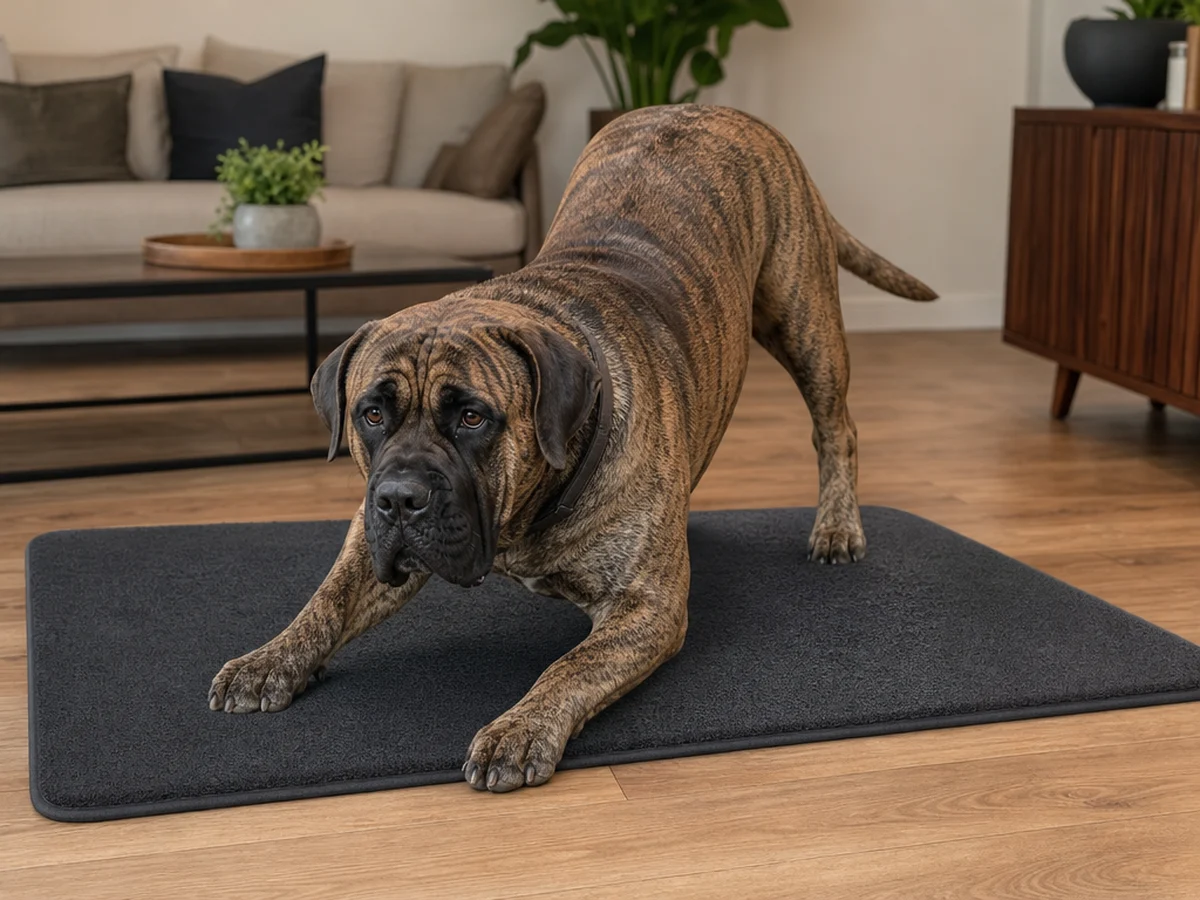
Choosing the Mat
Size comes first. The whole dog should fit when stretched out on one hip, with elbows and hips on the mat and not on the floor beside it. If a paw or haunch hangs off, the dog drifts toward the edge and you will mistake that for poor focus.
Next is the surface. Look for a rubber or grippy backing so the mat holds still when a muscular dog drops onto it, plus enough padding to cushion joints on hard floors. Drooling is average for the breed, so pick a cover you can launder often. Choose something that looks different from every other bed in the house, because a distinct mat makes a clearer cue. A second, foldable mat lets the habit travel.
Handling the Gear
Use a flat collar or a well-fitted harness and a leash that stays loose. The leash is for getting to the mat, not for steering the dog onto it, because the food does the steering. If you find yourself hauling a dog toward the mat, it is not yet a place worth reaching, so go back to treats near it. For the walking skills behind this, see leash training a Boerboel.
Keep a treat pouch on your hip so rewards land within seconds. Leave the mat in one spot during the learning phase and move it in small steps. A mat that wanders around the house means nothing.
Training Spaces for Settling
Where you practice sets how hard the exercise is. A Boerboel rates 5 of 5 for watchdog nature, so the same mat can be easy in the back room and nearly impossible by the front door. Climb through the spaces in order, and drop back one row whenever the dog stops taking food.
Use this table as a ladder, moving down a row only when the row above feels dull. Repeat a level until your dog can relax there.
| Space | What makes it harder | Starting move |
|---|---|---|
| Quiet room | Almost nothing, apart from your own movement | Mark and treat all four paws on the mat, then the down |
| Living area | Family comings and goings, the television | Place the mat at the room's edge, out of the walking path |
| Kitchen at meal prep | Smells, dropped food, clattering | Pay often at first and keep the mat a few feet from the counter |
| Entry and door | Knocks, voices, strangers, the dog's guarding instinct | Start far from the door and shift the mat closer a little at a time |
| Outside or travel | New smells, other dogs, unfamiliar floors | Use the foldable mat and start somewhere quiet |
Shared spaces need extra thought. The breed scores 2 of 5 with other dogs, so a second dog on a nearby mat is a distraction of its own, and each dog needs a separate mat at a distance that keeps both relaxed. With a young child in the room, a gate or low barrier around the mat keeps the dog from being climbed on. The breed's 4 of 5 for young children describes tolerance, not a license to be tested.
The entry is where most plans fail, because that is where the dog's job feels strongest. Practice there last, when a mat in the living room is already boring.
Boerboel Settle Routines
Once the mat works in the quiet room, hang it on moments that already happen every day. Routines supply the repetitions, and a Boerboel who is affectionate with family, 5 of 5, does well on a predictable order of events. The timings below are sample patterns, so shorten or stretch them to match your dog.
Mealtimes
Send the dog to the mat just before you sit down, then pay a treat every so often while the family eats. Deliver it from a standing adult so begging never pays. For the first few weeks keep the whole sitting short, a few minutes, then lengthen it. Release the dog only after the plates are cleared. If they creep toward the table, shorten the gaps between treats or move the mat farther away.
Doorbell Moments
Cut the event into pieces. First a soft tap, then a louder knock, then the bell, then a voice, and each time pay on the mat before the dog reacts. Let them look at the door if they must. An alert is allowed, and the mat is where the alert ends. Pay the moment the dog turns away, then send them back.
When a real guest arrives, keep the leash on and ask for the mat. Only once the dog is lying down should the door open.
A popular tip is to tire the dog out before company arrives. For a vigilant Boerboel that often backfires, because a revved-up dog at the door is still a dog on duty. Rehearsal beats exhaustion, so spend that effort on mat practice.
Evening Downtime
Evenings are the easiest place to build duration. When you sit down, point the dog toward the mat, hand over a stuffed chew or a few treats, and then do something dull. A Boerboel rated 4 of 5 for mental stimulation needs a task, and a chew on the mat supplies one. If you leave the house, the same pairing helps, and crate training and separation anxiety covers the rest of the alone-time picture.
Mat Training Setbacks
Setbacks are information. Each one tells you which tool, the rewards, the gear or the space, is out of balance. Diagnose before you repeat the exercise, because repeating a failing step only teaches the failure.
The Dog Leaves the Mat
If the dog gets up in the first moments, the gaps between treats are too long, so pay faster and shorten the stay. If they leave after a distraction, the space is too hard for the current skill, so return to a quieter room. If they leave mid-stay with no trigger, check the mat itself, since a slippery surface or a hanging haunch is a common reason. Reset calmly, send the dog back with no fuss, and pay the return.
The Dog Paces
Pacing usually means the dog is working at a job. Look at where the mat sits. A spot facing the door invites patrol, so move it to a wall or a corner. Lower the difficulty, lengthen the quiet stretches only after the dog has lain down, and offer a chew to occupy the mouth. If pacing continues in easy settings even with a chew, or begins suddenly in a dog who used to settle, mention it to your veterinarian.
The Dog Gets Too Excited
An excited dog is usually reading your excitement or chewing on a treat that is too thrilling. Quiet your voice, slow your hands, and switch to a duller treat. Hold sessions to a few minutes and end before the dog winds up. If the arousal appears only around guests or other dogs, increase the distance, drop back a row on the ladder, and work there until the dog takes treats softly.
Boerboel Settle Signs and Red Flags
Judge the habit by the dog's body and choices, not by how long they stay put. The settle is taking hold when you see the following.
- The dog heads to the mat when dinner prep or a knock begins, before you say anything.
- Their body looks loose, with weight on one hip, soft eyes and a long, easy breath after the down.
- They return to the mat quickly after a disturbance, such as a dropped pan or a car door.
- They wait for the release word and take treats gently.
- The cue holds in a second room, with a visitor present, and on the foldable mat.
Other signs mean the problem is bigger than a plan you can run alone. If you notice any of these, bring in a qualified trainer or behaviorist who uses only reward-based methods.
- Guarding the mat or a chew, including a hard stare, growling or lip lifting as someone approaches.
- Tension that will not ease, such as a rigid body or fixed stare, even in easy settings after steady practice.
- Sudden restlessness in a dog who used to settle, which also deserves a veterinary check.
- Pacing, heavy panting or destruction when left alone.
A Boerboel is bred to be calm, stable and confident, and the mat gives that temperament a daily outlet in place of a self-appointed post at the door. Reward rest, keep the gear and the spaces matched to the dog's skill, and the settle becomes their own idea.
When a warning sign appears, bring in a professional early and keep regular vet visits on the calendar, because a strong dog is far easier to help before a habit has set. For the bigger picture of how this breed learns, see whether Boerboels are easy to train.
 Puppy trainingBoerboel Puppy Socialization: A Practical Early Plan
 Puppy trainingStop the Jumping and Mouthing Before Your Puppy Hits 100 Pounds
 BehaviorTerritorial at the Fence? Managing Property-Guarding Behavior