

A Boerboel puppy can turn an ordinary greeting into a tangle of paws, teeth and sleeves before anyone has decided what behavior to reward. Jumping seeks contact, mouthing explores and invites play, and both habits grow harder to manage as this fast-growing puppy gains size.
This article separates greeting jumps, playful mouthing, teething pressure, overlooked calm moments and the household routine that ties them together, so you can reward calmer behavior before the weight arrives. We have trained Boerboels for many years and focus on how they behave and learn. What we see is steady: the habits a puppy is paid for when small are the ones you must manage at 150 pounds.
How Boerboel Puppy Training Habits Form
To understand the habits, start with what this dog was built to be. The standard describes a dog with the drive and working structure to become a dependable family guardian, one who works with a handler as a team and has a willingness to please. In a puppy, that shows up as a dog tuned to people, eager for contact and quick to learn from whatever the people around them do.
Greeting Is Their Job
Dogs greet by getting close to a face. A small puppy cannot reach yours from the floor, so they climb. The behavior is not rude or dominant. It is a social dog doing the obvious thing, and it keeps happening because it works. People bend down, laugh, talk and touch, and every one of those is a payment.
Mouths Do the Exploring
Puppies have no hands, so the mouth investigates sleeves, fingers and ankles, and it also invites play. Mouthing at this stage is exploration and not aggression. A squeal, a game of tug-of-war with a hand or a wiggling finger all tell the puppy that teeth get results.
How a Cute Habit Becomes a Problem
Behavior that gets paid repeats, and the puppy keeps growing. Adult Boerboels commonly weigh 150–200 pounds and fall in the extra-large size category. The hop that once landed at your knees arrives at chest height with far more mass behind it. Nothing about the dog's intent changed. The physics did.
Boerboel Greetings and Play Biting
The fix has two halves. Management prevents the rehearsal, and rewards build the replacement. A leash, a baby gate or a closed door before a greeting stops a jump before it happens, and each prevented jump is one fewer repetition for the habit. Then you pay generously for the behavior you want, which is four paws on the floor.
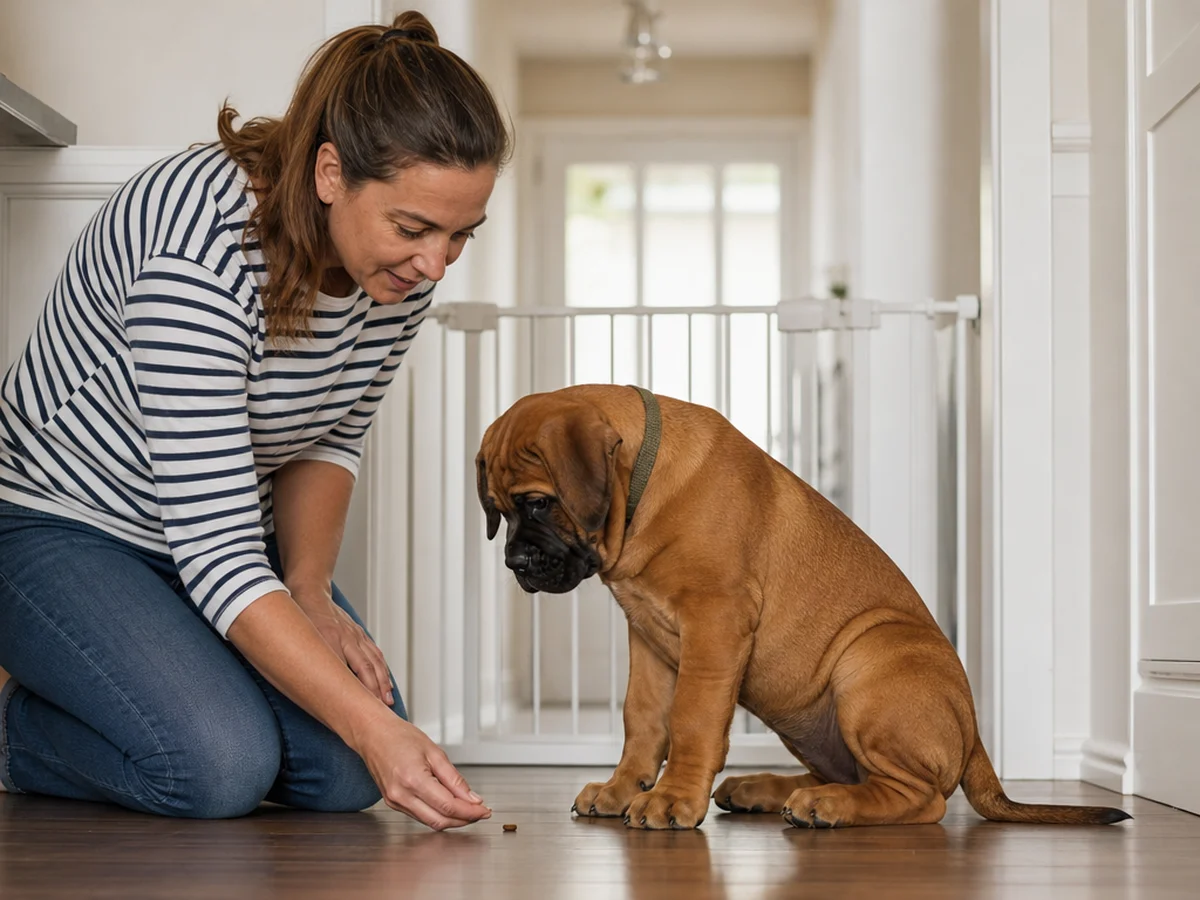
Pushing the puppy away, saying no or talking to them still counts as attention, and attention is what they are after. So the lesson is quiet: jumping makes the good things stop, and standing or sitting makes them start. A doorway routine you can follow looks like this:
- Before the door opens, have treats ready and keep the puppy leashed or on the far side of a baby gate.
- The instant your puppy's paws are planted on the ground, mark with your word, then bring a treat down low and deliver it right there.
- If the puppy jumps, turn away calmly for a moment without talking, then try again once they settle.
- Let a guest greet the puppy only while all four paws stay down, and ask them to follow the same steps.
- Repeat in short bursts, in different rooms and with different people, so the habit is not tied to one doorway.
The rule has to be the same for every person and every day. Everyone in the family must follow the training plan without exceptions, because a dog who is permitted to jump with some people or at certain times never learns that there is a rule at all.
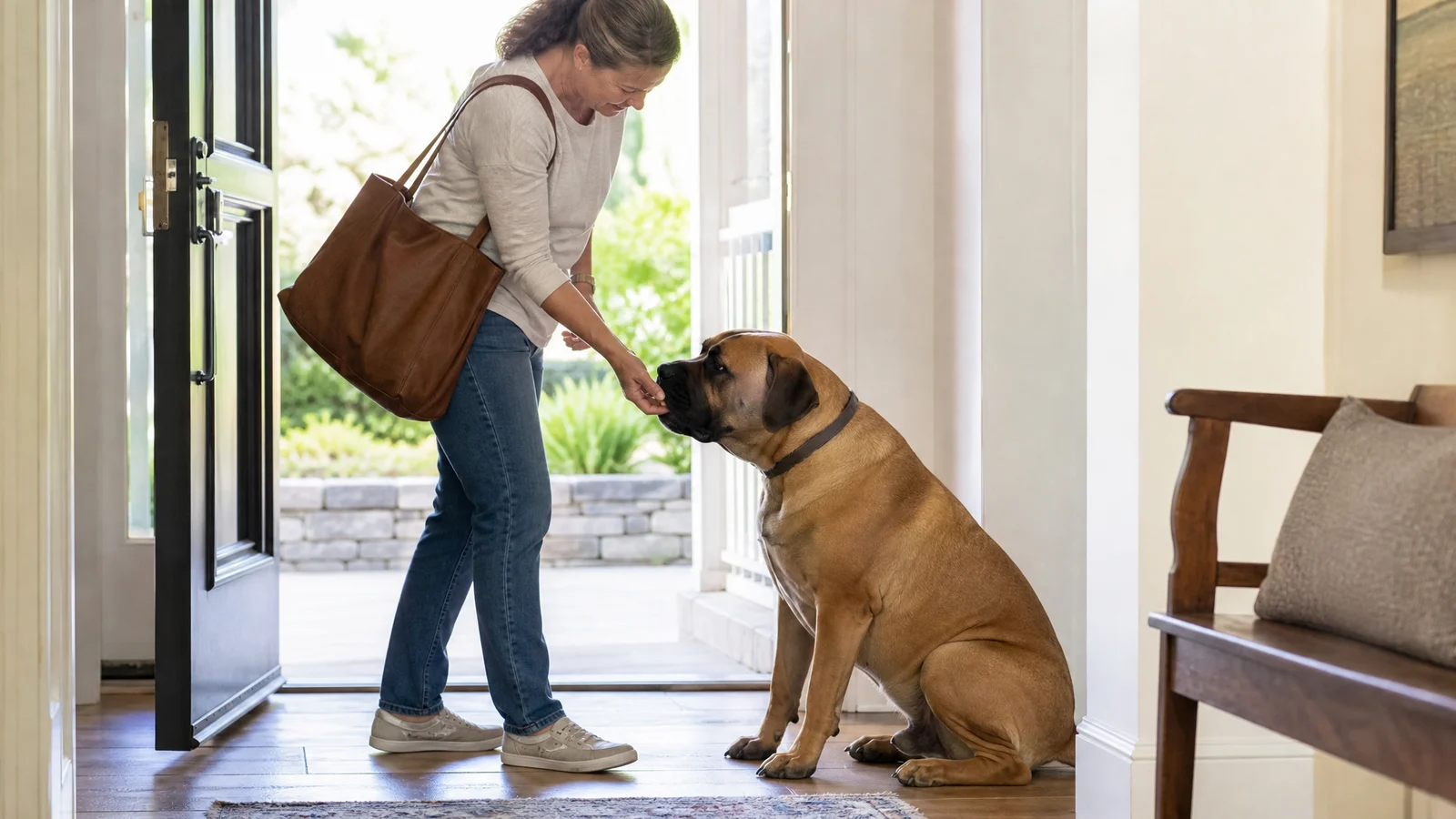
Strangers need a thought of their own. The breed standard says Boerboels should be discerning and accepting of friendly strangers with proper introductions, although many remain reserved and aloof. So do not push your puppy toward every guest. Let them approach at their own pace, reward four paws down, and ask visitors to ignore the puppy until things are calm.
Teething Pressure in a Boerboel
Mouthing often seems to get worse just when you expected it to fade. A likely cause is teething, when baby teeth are replaced by adult teeth and chewing seems to soothe sore gums. Whatever the exact trigger, a bigger puppy with a stronger jaw needs outlets better than your hands, your furniture and the legs of the table.
Chew Substitutes That Work
Offer sturdy chews sized for a large dog, in a few textures, and rotate them so they stay interesting. Supervise, and throw away anything cracked or coming apart. Keep a chew within reach in every room you use, because a substitute only helps when it is available the instant a mouth opens. A regular vet visit during the teething months is also a good time to have someone check the mouth.
Calm Redirection Without Rough Handling
When teeth touch skin, stay quiet, hand over a chew or toy, and praise when the puppy takes it. Do not grab the muzzle or wrestle the puppy away, since handling like that turns mouthing into a game and makes a strong dog stronger in the contest. If the nibbling continues, stop the play, stand up and step away for a short break. Teeth make the fun disappear, and calm brings it back.
Puppies mouth more when overtired or overexcited, so end play before it turns frantic and offer a quiet rest on a bed or in a pen with a chew. This is not a punishment. It lowers the arousal that was driving the behavior.
How Long Mouthing Lasts
Be patient and realistic. Many puppies start to grow out of mouthing by about 5 to 6 months, yet a larger, slower-maturing dog may keep at it through the first year, and sometimes up to 18–24 months. Watch the trend rather than any single day. It should keep decreasing, and steady rewards for gentleness are what keep it moving that way.
What Does Calm Puppy Training Reward?
Calm is easy to miss because nothing dramatic happens, so catch it and pay for it until it becomes the puppy's habit. Calm means a settled body, with paws down, mouth soft and eyes on you or on nothing in particular. It is easy to overlook because nothing is happening, which is exactly why it needs deliberate payment.
Start by teaching a marker word. Pick a brief, distinct sound, like yes, and use it to pinpoint the exact second the puppy does something you want paid. Because it is so precise, you can mark a quiet moment from across the room without breaking it. To build the link, pair the word with a treat straight away, and repeat this a few times until the puppy turns toward you the moment they hear it.
Marking Calm on Purpose
Then start marking calm on purpose. Mark a puppy lying quietly beside you, a puppy who sits when a guest walks in, a puppy who holds a gentle mouth while taking a treat. In the beginning pay for almost any calm moment. Over the following days, stretch the pause before your marker, so that settling for a few seconds earns more than a split second of stillness.
Keep the rewards varied and small. Treats, praise, a calm scratch on the chest, a favorite chew and a release into play all count as payment. Life rewards work too: the leash goes on after four paws are down, and the door opens when the puppy is calm. A willing-to-please breed responds well to this, and a puppy who is paid for calm at every doorway will start offering it before you ask.
Daily Training for a Boerboel Puppy
Boerboel puppies are known to be easygoing and pliant, and inexperienced owners may assume the dog will stay that way. Consistent training, though, has to be well underway before those qualities fade. Read that as a deadline with no date attached.
The reasoning is simple. Pliant means the puppy is easy to guide right now, and a puppy who is easy to guide learns your rules and your accidents equally well. Strength, meanwhile, keeps rising. The two lines cross at some point, and where they cross varies from dog to dog, so we cannot give you a reliable date. The safer plan is to treat every easy week as training time.
Keep the Easy Phase Useful
The same source adds that early socialization is a must for this breed, as is structured, long-term obedience training started at a young age. Notice the words long-term. A few weeks of lessons followed by a pause is how a calm puppy turns into a pushy adolescent, because the old rewards are still on offer and the new ones stopped.
Build Practice Into the Day
Short and frequent beats long and occasional. Build practice into moments that already happen in your day, such as meals, arrivals home, the doorbell and the end of a play session. A puppy rehearses these situations every day anyway, so you are only deciding what gets rehearsed.
Household rules decide whether any of this lasts. Everyone who handles the dog should respond to mouthing the same way, and mouthing allowed with some people and not others teaches the puppy to keep testing. Agree on the rules in a short family conversation and post them somewhere visible:
- Nobody rewards jumping with talking, touching or eye contact, and treats arrive only when paws are on the floor.
- Every person hands over a chew when teeth touch skin, and nobody uses hands as toys.
- Guests are asked to wait for calm before greeting, and the puppy is gated or leashed until they do.
- Play ends with a calm pause before it gets frantic, and the pause itself is rewarded.
Expect testing as the puppy grows. A rule they learned may seem to vanish, usually because someone stopped paying for it. Keep your markers crisp, raise your standards slowly and carry treats longer than feels necessary. Our month-by-month puppy timeline shows where these lessons fit as the dog matures.
Boerboel Calm at Home
This breed grows quickly into a powerful dog, and the easygoing nature of a young Boerboel is an opening and not a guarantee. A pliant puppy soaks up whatever gets paid, so the best protection is to make calm the most rewarding choice in your home, with every person, long before the dog is strong enough to make jumping and mouthing a real problem.
Start tonight with one small step. Put a handful of treats in your pocket and choose your marker word. The next time your puppy stands or sits with all four paws on the floor, say the word and deliver the treat at floor level right away. Then do it again at the next calm moment. That single habit, repeated through the days when your Boerboel is still easy to guide, is what an adult dog carries with them into every doorway.
 BehaviorTerritorial at the Fence? Managing Property-Guarding Behavior
 Training basicsAre Boerboels Easy to Train? Temperament and Trainability FAQ
 Puppy trainingYour Boerboel Puppy Month by Month: Training From 8 Weeks to 2 Years